Electrostatic disinfection is a way of applying disinfectant, not a new kind of disinfectant. A special sprayer gives the liquid an electrical charge as it leaves the nozzle, so the fine droplets are drawn toward surfaces and spread across them instead of clumping. How well it works still depends on the product in the tank, a surface that was cleaned first, and that surface staying wet long enough for the disinfectant to work.
Does your office need it? Usually not as a routine service. The CDC’s guidance on when and how to clean and disinfect a facility says cleaning alone removes most types of harmful germs from surfaces, and that disinfection is for areas where people have obviously been ill. An electrostatic office disinfecting treatment earns its place in specific situations: after an illness moves through the team, in large or cluttered shared spaces that must reopen quickly, and in clinical rooms.
Key Takeaways
- Electrostatic disinfection is an application method. The disinfectant does the killing, and its label should include directions for electrostatic spraying.
- Surfaces have to be cleaned first and stay visibly wet for the full contact time on the label.
- In EPA lab tests, the spray showed minimal “wrap-around” onto the back of objects, and 12 of 90 test surfaces dried completely within a typical 10-minute contact time.
- There’s no lasting shield: a disinfectant kills germs when it’s applied, not the ones that land afterward.
- For most offices, consistent high-touch cleaning and disinfecting is the foundation; an electrostatic treatment is a targeted add-on.
What Is Electrostatic Cleaning?
“Electrostatic cleaning,” “electrostatic sanitizing” and “electrostatic disinfecting” are used almost interchangeably in marketing, but they describe the same service: spraying a disinfectant onto surfaces that have already been cleaned. Despite the name, electrostatic cleaning doesn’t remove dirt or grease. A fine mist can’t lift soil the way a cloth and detergent can. (If the difference between those terms is fuzzy, our guide to cleaning vs. sanitizing vs. disinfecting in the workplace explains it.)
It’s also not an electrostatic duster, which uses static to grab dust, or an electrostatic air cleaner, which uses charge to trap airborne particles. And the technology isn’t new. The U.S. Environmental Protection Agency’s research on evaluating electrostatic sprayers for disinfectant application notes that these sprayers have been used for many years in other industries, such as applying pesticides to crops, and that their use for disinfection increased substantially with the COVID-19 outbreak.
How Electrostatic Spraying Works
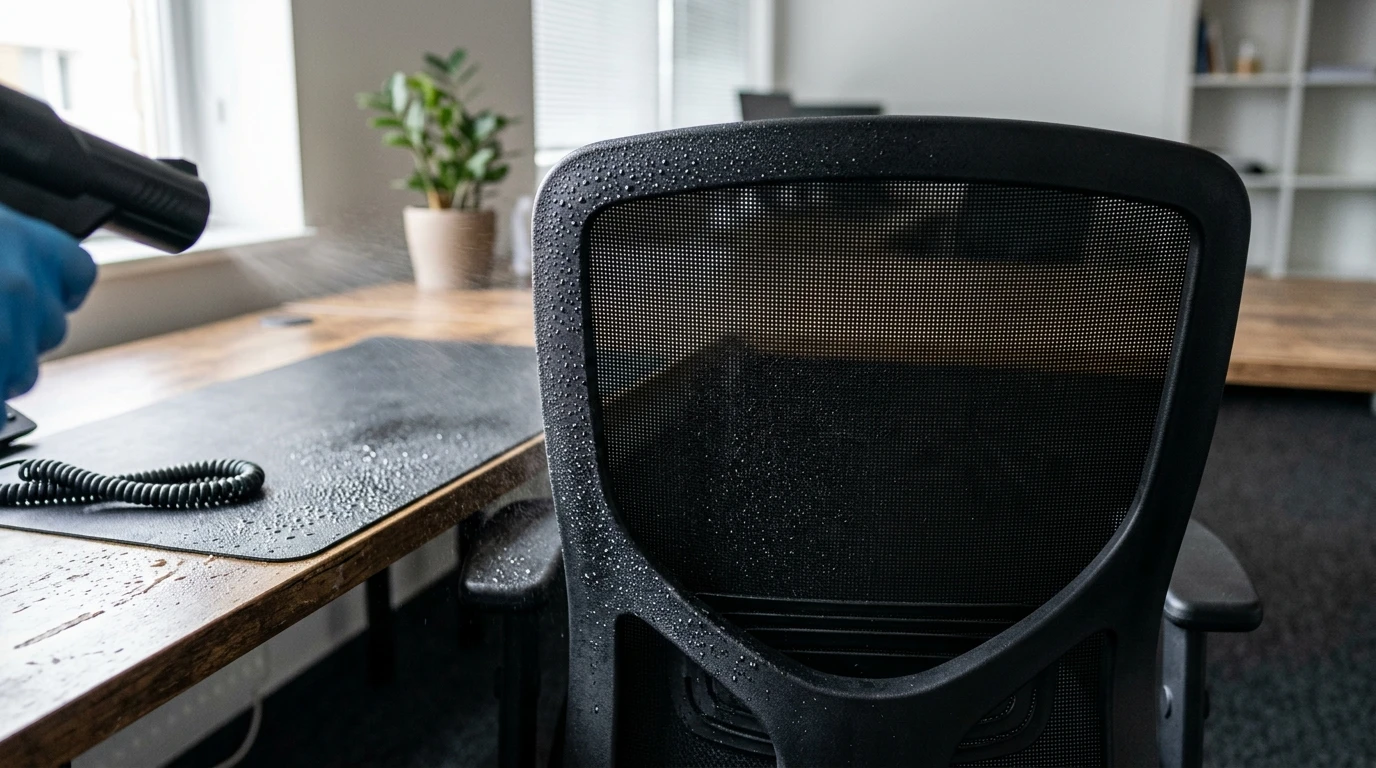
Whether the unit is handheld, a backpack model or a cart-style machine, here’s what an electrostatic sprayer does:
- Surfaces are cleaned first, because dirt gets between germs and the disinfectant.
- The disinfectant is mixed exactly as its label directs and loaded into the sprayer.
- The sprayer charges the droplets, in most units as they exit the nozzle, to improve how well they deposit onto surfaces.
- Because the droplets carry the same charge, they repel each other and spread out. The operator sprays from the manufacturer’s recommended distance, which ranged from about 2 to 10 feet across the sprayers EPA tested.
- The surface must stay visibly wet for the label’s full contact time. EPA’s researchers used 10 minutes as a typical contact time for many disinfectants.
- The room stays closed for the re-entry time, gets aired out, and any residue the label says to remove is wiped off.
The sprayer itself doesn’t kill anything. In EPA’s words, an electrostatic sprayer “is only as effective as the disinfectant chemical being sprayed.”
What Goes in an Electrostatic Sprayer?
An EPA-registered disinfectant whose label specifically includes directions for electrostatic spraying. EPA’s guidance on fogging, fumigation and electrostatic spraying says that unless the label includes those directions, EPA does not recommend the method, because it hasn’t evaluated the product’s safety and efficacy for uses not on the label. Archived COVID-era CDC guidance on electrostatic sprayers and foggers adds that disinfectants are approved for certain devices and aren’t interchangeable. To check a product, use its EPA registration number, which EPA’s page on selected EPA-registered disinfectants calls the only way to accurately identify one.
What EPA’s Lab Tests Found About Electrostatic Disinfection
Provider websites tend to repeat the same promises: 360-degree coverage, an even coat, less chemical. EPA researchers tested six electrostatic sprayers, two foggers and a hand-pumped garden sprayer, and published the peer-reviewed results in PLOS ONE in 2021. Here’s how the claims held up:
| Common claim | What EPA researchers found | What it means for your office |
|---|---|---|
| “Wraps around objects for 360° coverage” | Minimal wrap-around onto the back of an 8-inch-diameter cylinder, even with the highest-charge sprayer | Chair backs, cords and the far side of objects still need a deliberate pass or a wipe |
| “An even coat every time” | 12 of 90 test surfaces were completely dry after 10 minutes, most of them vertical; drying was uneven | Walls, doors and partitions need wetness checks and re-spraying |
| “A charged spray covers better” | One electrostatic sprayer showed no measurable charge; the charge needed for virus disinfection isn’t known | Equipment quality and upkeep matter |
| “Uses less disinfectant” | Both an advantage and a disadvantage: less liquid can mean the surface dries before the contact time ends | Product savings shouldn’t cost contact time |
| “Nothing harmful in the air” | Active-ingredient loss to the air was minimal for the two disinfectants tested, but smaller droplets are more readily inhaled | Only the applicator stays in the room; follow the re-entry time |
The wetness test used water at about 70°F (21°C) and 35% relative humidity, and EPA notes that drying time depends on coverage, the disinfectant, the material, temperature, humidity and air flow, so real offices will vary. None of this means electrostatic disinfection doesn’t work; it means results depend on the product, the equipment and the technician. In its summary of the research, EPA also noted that in most cases, cleaning with soap or detergent is enough to reduce the COVID-19 virus on surfaces.
Electrostatic Spraying vs. Wipe-Down Disinfection vs. Fogging
People often weigh an electrostatic sprayer vs. a fogger, but for an office the useful comparison includes plain wipe-down disinfection:
| Method | How it applies disinfectant | Best for | Main limitation |
|---|---|---|---|
| Spray-and-wipe or pre-saturated wipes | By hand, directly on each surface | Daily high-touch points: handles, desks, keyboards, counters | Slow on large or complex areas |
| Electrostatic spraying | Charged droplets from a trained operator, about 2–10 ft away | Large or cluttered shared areas, complex objects, quick turnarounds | Little wrap-around; contact time not guaranteed; label must allow it |
| Fogging (uncharged) | Fills a room with mist, usually with no operator present | Specialized uses, only with products labeled for fogging | Not targeted; room must be empty |
The CDC’s facility guidance says fogging, fumigation and wide-area or electrostatic spraying are not recommended as primary methods. They can supplement routine cleaning and disinfection, not replace it.
Benefits of Electrostatic Disinfecting — and Its Limits
Where It Helps
- Covering large or cluttered areas, like rows of desks and shared workstations, faster than wiping by hand.
- Reaching complex objects such as chair frames, railings and shared equipment.
- Quick turnarounds: the archived CDC guidance says these devices could be more practical when a space is needed quickly and some surfaces are very hard to disinfect by hand, if trained professionals apply them.
Where It Falls Short
- It doesn’t clean; soil has to come off first.
- It gives no lasting protection. EPA states that registered surface disinfectants kill viruses at the time they are used and won’t protect against new particles that land later.
- Contact time isn’t guaranteed, as the EPA wetness tests show.
- It needs extra care around food areas, children and people with asthma.
- Vendor percentages for time or chemical savings circulate widely, but we found no independent data behind them.
Does Your Office Need Electrostatic Disinfection?
The CDC’s facility guidance says to clean high-touch surfaces regularly, notes that high-traffic areas may need more frequent cleaning or disinfection, and points disinfection at areas where people have obviously been ill, such as after someone vomits. For flu, the CDC explains that the virus spreads mainly by droplets when sick people cough, sneeze or talk, and less often through touching a contaminated surface. Surfaces are one layer of protection, not the whole picture. Match your situation to an approach:
| Office situation | Recommended approach | Why |
|---|---|---|
| Small or standard office, no illness going around | Routine cleaning plus regular high-touch disinfection | Cleaning alone removes most germs (CDC) |
| Stomach bug or flu moving through the team, or someone was visibly ill at work | Targeted disinfection of affected areas; an electrostatic treatment of shared zones can make sense | CDC: disinfect where people have obviously been ill |
| Large open-plan office, coworking space or hot desks that must reopen next morning | Periodic electrostatic treatment as an add-on to routine cleaning | Many complex shared surfaces and quick reuse |
| Medical or dental office | Clinical disinfection protocols, with electrostatic spraying as one tool for room turnovers | Patient-care rooms follow stricter infection-control routines |
| Break room, kitchenette or a kids’ corner in reception | Manual disinfection with wipes or spray-and-wipe, not spraying | CDC: extreme caution in food areas; children are more vulnerable |
| Server room, lab or storage with flammable products | Don’t spray; wipe instead | Static discharge risks to electronics and near flammables (see safety section) |
When Routine Office Disinfecting Is Enough
For most offices, the answer is a dependable routine: daily attention to door handles, light switches, shared keyboards and break-room counters, plus deeper work on a schedule. See what’s included in a recurring office cleaning plan, the high-touch points in our commercial office cleaning checklist, and our comparison of daily vs. weekly office cleaning to set the frequency.
When an Electrostatic Treatment Makes Sense
It’s worth it when a large shared space needs disinfecting after an illness, when complex surfaces would take hours to wipe, or when rooms turn over constantly, as in a clinic. For healthcare practices, our guide to choosing a medical office cleaning provider in Green Bay and our infection control checklist for dental clinics cover the wider protocol electrostatic spraying should fit into.
Safety Rules — Including Wisconsin Winter Precautions
- Only the applicator, wearing appropriate protective equipment, should be in the room, and everyone stays out for the label’s re-entry time (CDC).
- Air the space out afterward; the CDC suggests opening windows and doors if possible.
- Remove chemical residue as the label directs before others come back, especially from desks and break-room counters.
- Children and people with asthma are more vulnerable to certain chemicals.
- Keep sprayers away from flammable liquids, gases and dust. A safety bulletin from Nova Scotia’s Department of Labour, Skills and Immigration, a Canadian provincial workplace-safety regulator, warns that electrostatic discharge is a potential ignition hazard, and that the risk is higher in winter, when dry air lets static build up.
- The same bulletin notes that electrostatic discharge can destroy semiconductor electronics and may affect pacemakers, so tell staff before a treatment.
That winter point matters in Wisconsin. In January, nobody props office windows open, so schedule treatments for evenings or weekends, keep the building’s ventilation running, and give the space time to clear before morning; our article on after-hours office cleaning explains why many offices already work this way. If chemical sensitivity is a concern for your staff, our guide to green office cleaning solutions covers lower-impact options for everyday cleaning.
How to Prepare Your Office for an Electrostatic Treatment
The general steps for preparing for your office’s first professional deep clean apply here, plus a few specific to spraying:
- Book an after-hours or weekend window so the re-entry time passes before staff return.
- Clear papers, mail and personal items off desks.
- Put away food, dishes and coffee gear, and clear break-room counters.
- Power down sensitive electronics, and cover or move them as your provider directs.
- Move flammable products, such as alcohol-based hand sanitizer stock and aerosol cans, out of the treatment zones.
- Confirm the re-entry time and who will air out the space and wipe any required residue before people arrive.
How Long Does Electrostatic Cleaning Last?
Only until the next germ lands. Electrostatic cleaning leaves no protective shield: it’s the same disinfectant applied a different way, and EPA states that a previously applied disinfectant won’t protect against new viral particles. The next cough, handshake or desk lunch starts the clock over.
Some providers in local search results advertise protection that lasts for days. That can only hold for a product specifically registered for residual effectiveness, so ask to see the label. How often to treat should follow occupancy, illness season and outbreaks; weekly or monthly plans are business choices, not health standards.
What Does Electrostatic Disinfection Cost?
We found no reliable public pricing from an authoritative source, so rather than quote a number that may not fit your building, here’s what drives the cost of electrostatic disinfection:
- Square footage, and how cluttered or complex the space is.
- Whether pre-cleaning is included.
- A one-time treatment vs. an add-on to a recurring cleaning plan.
- After-hours or weekend timing.
- The product, which must be labeled for electrostatic application.
- Documentation needs, which are higher for clinics.
Buying your own sprayer doesn’t remove the label, training and protective-equipment requirements above. For most businesses, pricing treatments as part of commercial cleaning services for your office gives the clearest picture of the total cost.
7 Questions to Ask Before You Book Electrostatic Disinfection
- Which product will you use, and what’s its EPA registration number?
- Does that label include directions for electrostatic application?
- Is pre-cleaning included, or do we need to clean first?
- What’s the contact time, and how do you make sure surfaces stay wet that long?
- Who stays in the room during spraying, and when can staff come back?
- How do you handle the break room, food-contact surfaces and electronics?
- What do you document after each treatment, such as areas treated, product used and re-entry time?
How Badger Luxe Fits Electrostatic Disinfection Into Your Office Cleaning Plan
At Badger Luxe Cleaning, we start with the question in this article’s title: does your office actually need it? Often the better investment is a consistent high-touch cleaning and disinfecting routine built on a customized checklist for your space. When a targeted electrostatic treatment makes sense, such as after an illness or in a clinic, it fits into that plan rather than replacing it.
Our background-checked, highly trained local professionals use non-toxic, eco-friendly green cleaning products for everyday work and apply disinfectants where they’re actually needed. There’s no long-term contract: book one-time or month-to-month and cancel anytime without penalty. With local Wisconsin expertise and transparent pricing, we serve offices from our home base in Green Bay to commercial cleaning in Madison and commercial cleaning in Milwaukee.
FAQ
Is electrostatic disinfection safe for office electronics?
Electrostatic discharge can destroy semiconductor electronics, according to the Nova Scotia bulletin cited above. Power down sensitive equipment, cover or move it as your provider directs, and wipe keyboards, mice and phones by hand instead.
Does electrostatic spraying leave a residue?
It can. The archived CDC guidance advises removing chemical residue before others enter the room, and some labels require wiping or rinsing after the contact time, so ask your provider who handles that step.
Is electrostatic spraying better than wiping surfaces?
They do different jobs. Wiping removes soil and gives controlled coverage of each high-touch point, while spraying covers large or complex areas faster but showed limited wrap-around and uneven drying in EPA tests. For most offices, spraying supplements wiping rather than replacing it.
Can we stay in the office while it’s being sprayed?
No. Only the applicator should be in the room, and everyone else stays out for the re-entry time on the product label.
Do we need electrostatic disinfection after someone in the office gets sick?
Not automatically. The CDC recommends disinfecting areas where someone was obviously ill, which targeted manual disinfection often handles. For a large shared area that has to be ready the next day, an electrostatic treatment can be a practical add-on.
Not sure whether your office needs electrostatic disinfection or just a sharper routine? Call our Green Bay team at (920) 777-9609 or email nathan@badgerluxecleaning.com to talk through your space and the cleaning plan that fits it.