
To deep clean carpet without a machine, vacuum slowly, pre-treat any spots, then work a very weak dish-soap solution into the carpet one small section at a time with a spray bottle and a stiff brush. Rinse the soap back out with a vinegar-and-water mist followed by plain water, blot hard with white towels, and dry the room fast with fans or a dehumidifier. That’s how to clean carpet without a machine and still reach the soil a vacuum leaves behind, and the rinse is the step that decides whether the result lasts.
Set aside an afternoon for a typical room, plus drying time. Knowing how to clean a carpet without a carpet cleaner won’t make hand work equal to professional extraction, but these steps let you deep clean carpet at home with basic supplies and get a noticeably fresher floor between professional cleanings.
Key Takeaways
- Keep homemade soap solutions weak: the carpet industry’s limit is 1/4 teaspoon of clear dish liquid per cup of water, or about 1 teaspoon per quart.
- Rinsing matters as much as scrubbing. Soap left in the fibers attracts dirt and makes carpet look dirty again quickly.
- Mist, don’t soak. Carpet and its backing should be dry within 24–48 hours to limit the risk of mold.
- Wool and natural fibers need low-alkaline, bleach-free products, so check your fiber before you mix anything.
- Hand cleaning is a refresh between professional deep cleans, which the carpet industry recommends every 12–18 months.
Can You Really Deep Clean Carpet by Hand?
Yes, within limits. A “deep” clean goes after what regular vacuuming leaves behind: oily soil clinging to the fibers, old residue from past spot treatments, and odors. If you’re wondering how to deep clean carpet by hand well, the answer has less to do with scrubbing power than with weak solutions, thorough rinsing and fast drying.
What you can’t do by hand is match a machine’s suction. Soil that has worked down to the base of the yarns, the backing or the pad mostly stays put. That’s why the Carpet and Rug Institute (CRI) recommends a professional deep clean every 12 to 18 months to remove embedded dirt and grime, and carpet manufacturer Shaw Floors recommends professional hot water extraction anywhere from 6 to 18 months, depending on traffic. CRI also notes that some carpet manufacturers recommend, and sometimes require, cleaners certified under its Seal of Approval program, so if your carpet is new, read the warranty before you start.
Check Your Carpet Fiber First
The right solution depends on what your carpet is made of. Use the table below to match your fiber to safe products before you mix anything.
| Fiber | How to tell | Safe to use | Avoid |
|---|---|---|---|
| Nylon, polyester, olefin (most wall-to-wall carpet) | Label, receipt or manufacturer’s spec sheet | Weak clear dish-liquid wash, white vinegar rinse, plain water | Laundry detergent, dishwasher detergent, bleach |
| Wool and wool blends | Label, receipt or manufacturer | Low-alkaline, bleach-free products; minimal moisture | Alkaline cleaners, bleach, over-wetting |
| Sisal, jute, seagrass and other plant fibers | Label or manufacturer; coarse, matte texture | Vacuuming and dry methods; ask the maker before any wet cleaning | Soaking, bleach, guessing |
For every fiber, CRI’s dish-detergent cautions rule out laundry detergent, which may contain optical brighteners that dye the fiber, and automatic dishwasher detergent, since many contain bleaching agents that destroy dyes and some fibers. For wool, The WoolSafe Organisation advises low-alkalinity products with no added bleaches, warning that high alkalinity can cause color bleeding, jute staining on the surface of light-colored carpets and, in extreme cases, yellowing and weakening of the wool. Baking soda is mildly alkaline, so test it on a hidden patch of wool first. And identify fiber from the label or manufacturer, never with a burn test.
Whatever the fiber, follow CRI’s pretesting and rinsing guidance: try each solution in an inconspicuous area first, such as inside a closet, then blot with a white cloth. If color transfers to the cloth or the fiber changes texture, don’t use that solution.
What You’ll Need
Everything for DIY carpet cleaning without a machine fits in a bucket or two:
- A vacuum with an edge or crevice tool
- A spray bottle with a mist setting
- Two buckets: one for the wash solution, one for rinse water
- A stiff carpet brush (not a wire brush)
- A stack of white cotton or microfiber towels, so you can see soil and any dye transfer
- Clear dish liquid with no bleach or lanolin
- Plain white vinegar
- Baking soda
- Distilled water (optional, for fixing spots that reappear)
- A fan or dehumidifier, or both
- Rubber gloves
Homemade Carpet Cleaner Solution: Get the Ratio Right
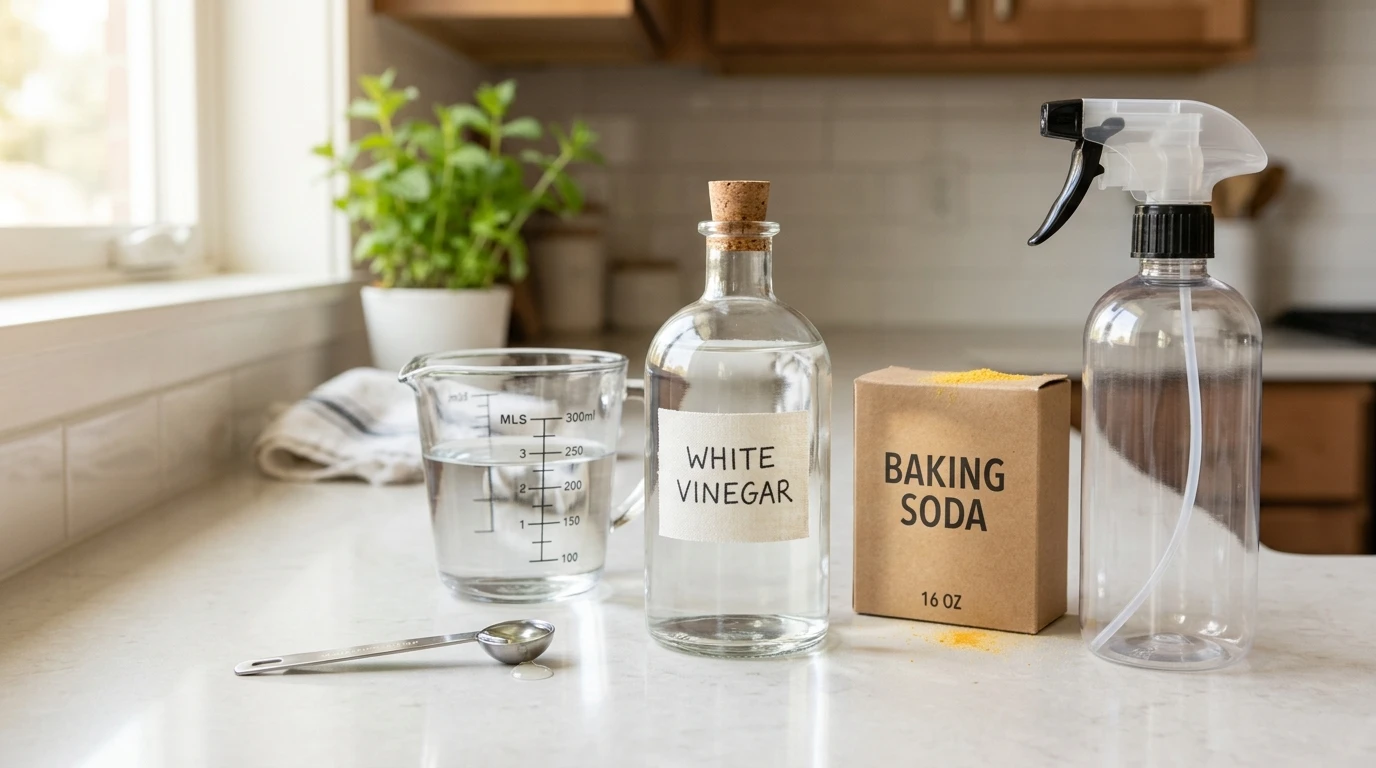
A homemade carpet cleaner doesn’t need anything exotic: most DIY carpet cleaner recipes come down to dish liquid, white vinegar and water (for kitchen and bathroom mixes, see our homemade cleaning recipes). What matters is strength. The Carpet and Rug Institute’s stain removal tips set the homemade solution at 1/4 teaspoon of clear, non-bleach, non-lanolin dishwashing liquid in one cup of water, and CRI’s spot-cleaning guidance adds, in capital letters, never to use a stronger concentration. The vinegar mix assumes ordinary 5% white vinegar, not the stronger cleaning vinegar.
| Solution | Small batch | Bucket batch | Use it for |
|---|---|---|---|
| Dish-liquid wash | 1/4 tsp dish liquid + 1 cup water | 1 tsp per 1 quart water, or 4 tsp per 1 gallon | The main shampoo pass |
| Vinegar rinse | 1 cup white vinegar + 2 cups water | 1 quart white vinegar + 2 quarts water | Cutting soap residue and salt |
| Plain rinse | Lukewarm tap water | Lukewarm tap water | Final rinse passes |
| Baking soda | Light, even dry dusting | Light, even dry dusting | Deodorizing before any wet step |
The bucket amounts are simple arithmetic from CRI’s ratio: 4 cups make a quart and 4 quarts make a gallon. Compare that with a mix you’ll see in many online guides, 1 tablespoon of dish soap per 2 cups of water. That works out to 1.5 teaspoons per cup, six times CRI’s maximum. Extra soap doesn’t clean better. CRI warns that many spot removal solutions leave residues in the carpet that may attract soil, and the IICRC’s consumer carpet care tip sheet lists excessive soap residue from DIY homeowner attempts among the causes of rapid re-soiling.
Run a Residue Test Before You Start
Before you commit a whole room, try a simple check from the IICRC (the Institute of Inspection, Cleaning and Restoration Certification). Pour about half an ounce of the solution, mixed at the strength you plan to use, into a small glass and let it evaporate. If it leaves a sticky residue in the glass, it will leave the same residue in your carpet. Set it up a day ahead so the water has time to evaporate. The test works for store-bought carpet shampoos too, and the IICRC also advises staying away from products that claim no rinsing is needed.
How to Deep Clean Carpet Without a Machine: Step by Step
The best way to clean carpet without a machine is a sequence, not a single trick. Each step sets up the next one:
- Clear the room and vacuum slowly.
- Deodorize with baking soda, then vacuum it out.
- Pre-treat stains and problem spots.
- Shampoo the carpet by hand, one section at a time.
- Rinse out the soap.
- Blot, weight and dry.
- Vacuum again and put furniture back only when the carpet is dry.
Step 1: Clear the Room and Vacuum Slowly
Move out everything you can lift, and plan to work around heavy pieces. Then vacuum slowly, in overlapping passes from more than one direction, using the edge tool along baseboards where dust collects. A rushed pass leaves grit behind, and any grit left now turns into mud once the carpet gets wet. CRI recommends vacuuming at least once a week anyway, and more often in high-traffic rooms. If allergies are a concern in your home, our guide to HEPA vacuum cleaning explains what a sealed HEPA filter adds.
Step 2: Deodorize With Baking Soda (and Keep the Vinegar for Later)
If you’re looking up how to clean carpet with baking soda, the honest answer is that it deodorizes more than it cleans. Sprinkle a light, even dusting over the carpet and leave it for at least 15 minutes, longer for stronger odors, as Which? recommends. Then vacuum it out thoroughly before any wet step, so it doesn’t turn into paste once water hits it.
Many recipes for how to clean carpet with baking soda and vinegar mix the two into a fizzing paste. Skip that. Baking soda is alkaline and vinegar is acidic, so used together they cancel each other out, as Which? points out. Utah State University Extension explains that vinegar works by neutralizing alkaline substances, while baking soda adsorbs odors and neutralizes acid-based ones. The fizz is the two reacting with each other, not dirt lifting out. Use them separately: that’s how to clean carpet with vinegar effectively, as the rinse that strips soap residue later, not as a stand-alone cleaner.
Step 3: Pre-Treat Stains and Problem Spots
Treat individual stains before the whole-room wash, while you can still see exactly where they are. Our guide to getting stains out of carpet walks through specific spills one by one. For pet urine, use an enzyme cleaner (see how to get rid of pet odor in the house), and never use a steam cleaner on urine spots: CRI warns that the heat will set the stain and the smell. For vomit, follow our step-by-step vomit cleanup first, then continue with the whole room.
Step 4: Shampoo the Carpet by Hand, One Section at a Time
This is how to shampoo carpet without a machine. Start at the wall farthest from the door so you finish at the exit without walking back over wet carpet. Work in sections about 3 feet by 3 feet, small enough that you can wash and rinse each one before it starts to dry.
Mist the dish-liquid wash onto the section with the spray bottle; don’t pour it. CRI recommends a mist-type sprayer specifically to prevent over-wetting, and water that soaks through to the backing and pad is slow to come back out. Work the solution in with the brush using short strokes in two directions, firmly but without grinding the bristles into the backing. Then press a white towel into the section and blot. If the towel comes up gray, the solution is doing its job. Overlap sections slightly to avoid visible lines. Learning how to clean carpet by hand is mostly patience: a light mist and a second pass beat one heavy soaking.
Step 5: Rinse Out the Soap
This is the step people are most tempted to skip, and it’s the one that decides whether your carpet stays clean. Mist each section with the vinegar rinse (1 part white vinegar to 2 parts water) and blot, then mist with plain lukewarm water and blot again. CRI’s guidance is to rinse several times with lukewarm tap water and blot after each rinse, and it warns that failing to completely rinse the solution from the fiber may cause accelerated soiling. Keep going until a fresh towel no longer feels slick or soapy against the carpet.
Step 6: Blot, Weight and Dry
Lay a thick folded towel over each section and stand on it, shifting your weight, to press water up out of the pile. Swap to a dry towel and repeat until the towels come up nearly dry. Then get air moving: point fans across the carpet surface, open windows if the air outside is dry, or close up the room and run a dehumidifier.
Step 7: Final Vacuum and Put Furniture Back Only When Dry
Once the carpet is completely dry, including down at the backing (see the next section), vacuum one more time, against the direction of the pile, to lift fibers that were flattened while wet. Only then bring furniture back. As a simple precaution, slip squares of aluminum foil or plastic under wooden or metal legs for the first day to keep wood-finish and rust marks off the freshly cleaned carpet.
How Long Does Carpet Take to Dry After Hand Cleaning?
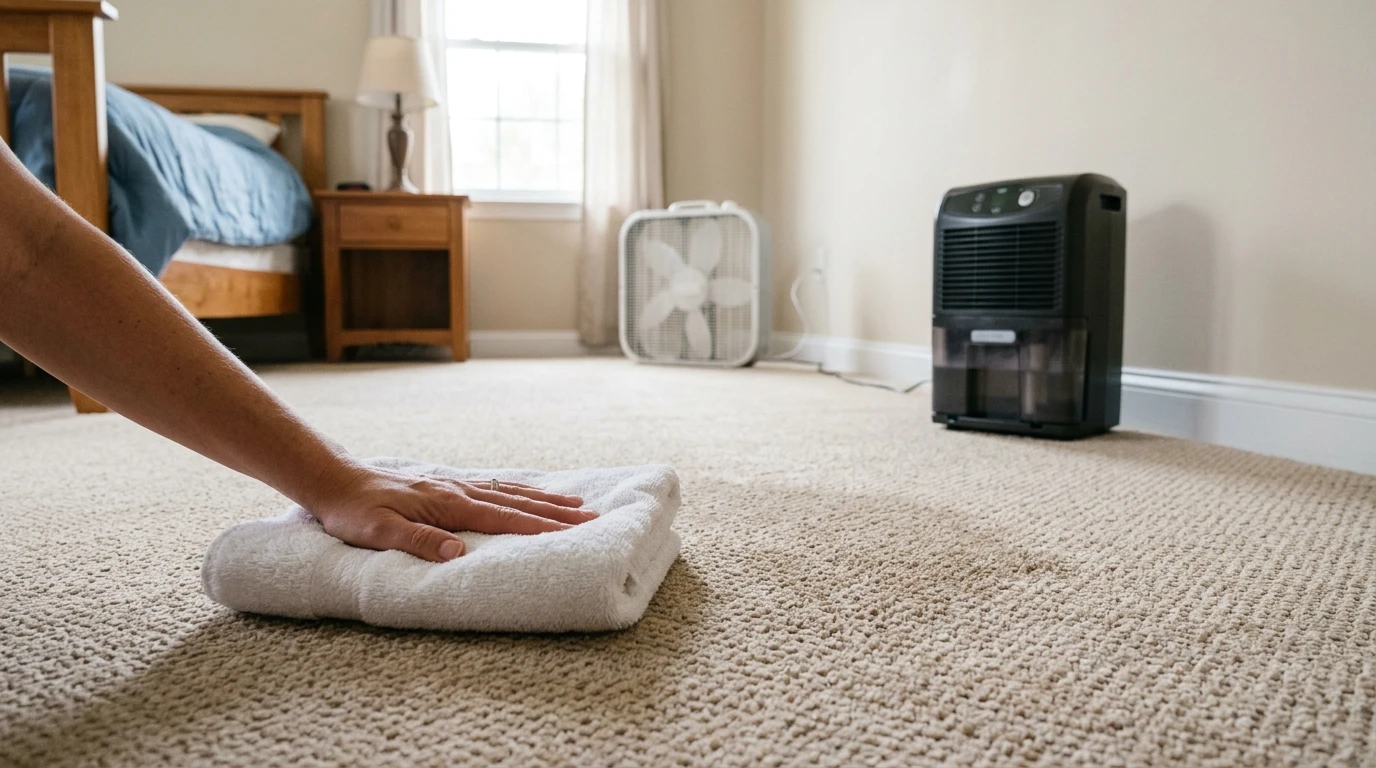
There’s no honest single number for how long carpet takes to dry. It depends on humidity, pile height, airflow and, above all, how much water you used. The benchmark that matters comes from the U.S. EPA’s mold remediation guidance: carpet and backing should be dried within 24 to 48 hours. The EPA calls that a guideline, since mold growth will not always occur after 48 hours, but it’s the right target.
Don’t judge by the surface. The IICRC notes that the absorbent pad under your carpet can stay wet for an extended time even when the fibers feel dry to the touch. To check, press a dry white paper towel firmly into the pile all the way down to the backing. If it comes up damp, keep drying. Knowing how to dry carpet after cleaning mostly comes down to moving air and removing moisture:
- Run fans across the carpet; the EPA lists fans as a way to accelerate drying.
- Use a dehumidifier with doors and windows closed, especially in humid weather or a basement room.
- Open windows only when the air outside is dry.
- A wet/dry shop vacuum, if you already own one, can pull extra water from the pile.
- For a room that dries slowly, CRI notes that a dry, absorbent cleaning compound can be used instead of a wet solution to minimize drying time.
- Never use a space heater or hair dryer; Which? advises against heat-drying carpet.
After It Dries: What You See and What It Means
Most problems with hand-cleaned carpet only show up after it dries. This table matches the most common results to their likely causes and fixes.
| What you see | Likely cause | What to do |
|---|---|---|
| Old spots reappear after drying | Wicking: soil deep in the yarns and backing rises to the tips as it dries | Wait 48 hrs, then use the towel fix below |
| Carpet looks dirty again within weeks | Soap residue attracting soil | Vinegar rinse, then plain-water rinse, blot |
| Stiff, sticky or crunchy fibers | Too much soap, not enough rinsing | Same rinse, more passes |
| Musty smell | Pad stayed wet too long | Fans and dehumidifier; call a pro if it lingers past 48 hrs |
| White, crusty film near entry doors | Ice-melt or road-salt residue | Use the Wisconsin method below |
| Faded or yellowed patch on wool or natural fiber | Alkaline or bleaching product | Stop and call a professional |
For wicking, the IICRC’s fix is to let the carpet dry for at least 48 hours, vacuum slowly from three or more directions, lightly mist the spot with distilled water and blot it, then cover it with 6–10 layers of white paper towel or a folded white towel. Put a plastic bag on top, weight it with books, and leave it for 6–8 hours so the towel draws the remaining soil up and out. Yellowed wool is different: WoolSafe links it to high alkalinity, so stop using the product and get a professional opinion.
Wisconsin Winters: Getting Road Salt and Ice Melt Out of Carpet
In Wisconsin, the carpet just inside the door takes a beating every winter, and the salt problem is growing: the Wisconsin DNR reports that the chlorides it measured rose from about 600,000 tons a year in the early 2000s to nearly 800,000 tons per year by 2018. Some of that salt comes indoors on boots. The IICRC lists road salt and ice melt tracked in from outside among the causes of rapid carpet re-soiling, and the white crust they leave needs more than a vacuum.
For de-icer residue, follow CRI’s de-icer removal steps:
- Vacuum up dry crystals and grit, or blot the area if it’s still slushy.
- Pretest the vinegar solution in a hidden area.
- Apply 1 cup of white vinegar mixed with 2 cups of water to a white cloth, not directly to the carpet, and work from the edges of the area toward the center.
- Let it sit a few minutes, then blot.
- Rinse with cold water and blot dry.
CRI also lists the 1/4-teaspoon dish solution as an alternative. Don’t leave salt stains until spring: CRI warns that delaying may cause the spill to become a permanent stain. Prevention is easier still. CRI advises using mats outside and inside entry doors to stop dirt at the door, and a boots-off spot right inside helps too. For salt on hardwood and tile, see our guide to keeping a home clean through Wisconsin winters.
Mistakes That Make Hand-Cleaned Carpet Worse
- Soaking instead of misting. Water that reaches the pad is slow to dry.
- Using more soap. As CRI puts it, more is not better.
- Reaching for laundry or dishwasher detergent. Both can permanently change carpet color.
- Mixing bleach with other cleaners. The Washington State Department of Health warns that bleach mixed with an acid such as vinegar gives off chlorine gas, and bleach mixed with ammonia produces toxic chloramines.
- Scrubbing hard. Work the brush firmly but gently; grinding into the backing does more harm than good.
- Heat-drying. Use moving air and a dehumidifier instead.
- Adding fragrance. Essential oils and lemon juice add residue you’ll have to rinse out.
- Skipping the rinse. Unrinsed soap is what makes hand-cleaned carpet re-soil fast.
- Putting furniture back on damp carpet. Wait until the backing is dry, not just the surface.
Hand Cleaning vs. Renting a Machine vs. Hiring a Pro
If you’re weighing how to deep clean carpet without a steam cleaner against simply renting one, here’s an honest look at professional carpet cleaning vs. DIY options.
| Option | Best for | What it can’t do | Watch out for |
|---|---|---|---|
| Hand cleaning | Single rooms, entries, refreshes between pro cleans | Pull deep soil from the backing and pad | Over-wetting, soap residue |
| Renting or buying a carpet cleaner | Whole floors, heavier soil | Replace periodic professional extraction | Too much shampoo, slow drying |
| Steam mop with carpet glider | Light surface refresh | Deep-clean the pile; it’s a surface tool | Never use on urine spots (heat sets them) |
| Professional hot water extraction | Embedded soil, every 6–18 months by traffic | Prevent soiling between visits | Check what your carpet maker requires |
If you decide a machine is worth it, our roundup of the best carpet cleaners compares popular models. Either way, hand cleaning stretches the time between professional deep cleans rather than replacing them.
Hand-Washing Your Carpet? Let Badger Luxe Cleaning Handle the Rest of the House
To be straightforward: Badger Luxe Cleaning doesn’t shampoo or extract carpets. What we do is take the rest of the house off your list, so your afternoon goes to the carpet instead of everything else.
Our recurring cleaning visits include vacuuming as part of the standard checklist, which keeps up the regular vacuuming CRI puts at the top of its carpet care advice. When the whole home needs a reset, our deep cleaning service covers baseboards, appliances, the insides of cabinets, drawers, ovens and refrigerators, windows, ceiling fans, blinds and the dust that settles on every surface. Moving out of a rental? Our move-out cleaning takes care of the kitchen, bathrooms and the rest of the unit while you focus on the carpet. Pricing is transparent, and you can estimate a deep clean with our deep cleaning cost calculator before you book.
Our cleaners are background-checked, highly trained local professionals who use non-toxic, eco-friendly cleaning products, the same “no harsh chemicals” thinking behind the carpet method above. Every plan follows a cleaning checklist customized to your home, and there’s no long-term contract: book one time or month to month, and cancel anytime without penalty. We know Wisconsin homes, from salty winter entryways to humid summer basements.
FAQ
Does vinegar and Dawn clean carpet?
Yes, if you use them separately and keep them weak. A clear dish liquid without bleach or lanolin, at 1/4 teaspoon per cup of water, does the washing, and a 1:2 white vinegar rinse afterward removes the soap residue. If you use Dawn, choose a clear variety, since that’s what CRI’s recipe calls for.
What pulls dirt out of carpet?
Dry soil comes out with slow vacuuming from several directions. Soil that’s bonded to the fibers needs a mild detergent to loosen it, rinse water to carry it, and absorbent white towels plus your body weight to pull that water back out. The one thing hand cleaning can’t fully replicate is a machine’s suction, which is why soil deep in the backing can wick back up as the carpet dries.
How often should you deep clean your carpet?
Vacuum at least weekly, more often in busy rooms, and schedule a professional deep clean every 12–18 months, per CRI. Shaw Floors puts the range at 6–18 months depending on traffic. Hand cleaning works well in between for high-traffic rooms and winter entries.
Can I use this method on carpeted stairs or area rugs?
Yes, with adjustments. If you’re working out how to clean carpet on stairs without a machine, use a smaller brush, work one tread at a time from the top down, and take extra care not to over-wet the edges, where water can run down the riser. For area rugs, check the care label first: small, washable rugs can be cleaned outdoors, while wool or handmade rugs are best left to a rug specialist.
Is hydrogen peroxide safe on carpet?
Sometimes. The IICRC uses 3% hydrogen peroxide to lift residual color from spots, but warns that bleaching around the spot may occur on natural fibers. Pretest it in a hidden area, keep it off wool and natural fibers unless the manufacturer approves, and never combine it with bleach; Washington’s health department lists hydrogen peroxide among the products that react with bleach.
Will hand cleaning my carpet help me get my security deposit back?
It helps with everyday soil and routine stains, but cleaning won’t undo damage such as burns, tears or permanent discoloration. Our guide to normal wear and tear vs. damage in Wisconsin explains how carpet condition is judged at move-out.
If you’d rather spend your weekend on the carpet than on the rest of the house, Badger Luxe Cleaning can help. Call our Green Bay team at (920) 777-9609 or email nathan@badgerluxecleaning.com to talk through a cleaning plan that fits your home.