
If you’re asking “why is my house so dusty?”, the short answer is that most household dust starts outside. It rides in on shoes, pets, open windows and air leaks, then mixes with skin flakes, fabric fibers and pet dander produced indoors. A house gets so dusty when more dust gets in (drafty windows, a busy entryway, a renovation), more is produced (carpets, bedding, pets), or not enough is removed (a dirty furnace filter, humidity out of range, or cleaning that just moves dust around). So if there’s so much dust in your house that it’s back a day after you clean, the fix is rarely “dust harder.” It’s finding which of those three is out of balance. Below: where dust comes from, the eight most common causes, a diagnostic table, and a realistic plan to stop it, including what changes in a Wisconsin winter.
Key Takeaways
- Researchers estimate that over 60% of house dust originates outdoors, so stopping dust at doors, windows and air leaks matters as much as dusting.
- Your furnace filter only cleans the air while the system is running, which the EPA says is usually less than 25% of the time. The EPA recommends a filter rated at least MERV 13 if your system can handle it.
- Keep indoor humidity under 50%, and lower still during deep cold snaps to avoid condensation on windows.
- Dry dusting and feather dusters mostly launch dust back into the air. A damp microfiber cloth, a HEPA vacuum and a top-to-bottom order keep it from resettling.
- Air duct cleaning isn’t a proven fix for everyday dust. The EPA suggests it only in specific situations, such as visible mold, vermin or clogged ducts.
- A steady weekly-and-monthly routine beats an occasional marathon clean.
Where Does Dust Come From? What Household Dust Is Actually Made Of
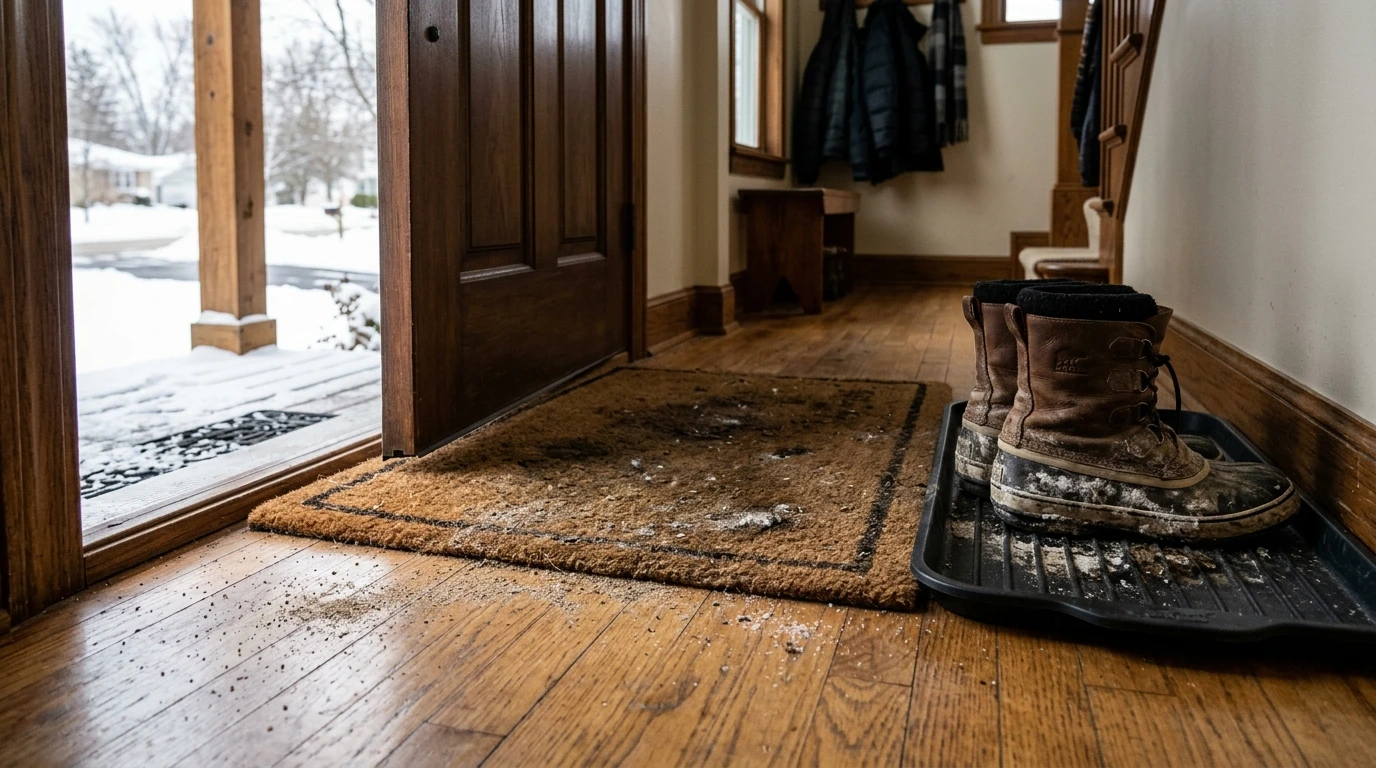
House dust isn’t one substance. It’s a mix of whatever your home and the outdoors shed, and the recipe varies from house to house. In research summarized by ScienceDaily, scientists described dust as a combination of dead skin shed by people, fibers from carpets and upholstered furniture, tracked-in soil, and airborne particles blown in from outdoors. According to the American College of Allergy, Asthma and Immunology (ACAAI), household dust can also include:
- Pet hair and dander
- Mold spores and pollen
- Dust mite body parts and droppings
- Cockroach body parts and droppings
So what causes dust in a house to build up? The biggest share isn’t made indoors at all. In that same research, David Layton and Paloma Beamer found that over 60 percent of house dust originates outdoors, using a model they applied to homes in the Midwest, which makes it a useful reference point for Wisconsin households. It also explains a common puzzle: a house nobody is living in still gets dusty, because outdoor particles keep drifting in whether anyone is home or not.
The popular idea that dust is “mostly dead skin” is only partly true. Skin flakes are part of the mix, and they’re food for dust mites, but the outdoors contributes more. That’s good news, because it means a large part of your dust problem can be stopped before it ever lands on a shelf.
Why Does My House Get So Dusty? 8 Common Causes
If you keep wondering why your house gets so dusty no matter how often you clean, work through these causes in order. The first few are the ones most homeowners overlook.
1. Your furnace filter is dirty, low-grade, or rarely running
Your HVAC system pulls air from the house through return vents, pushes it through a filter and sends it back out. If that filter is clogged, cheap or loose in its slot, dust just circulates. The EPA’s Guide to Air Cleaners in the Home recommends selecting a filter rated at least MERV 13, or as high as your system will accommodate, and notes that all filters need regular replacement because a dirty, overloaded filter won’t work well. Check your furnace manual or ask an HVAC technician before jumping to a higher rating, since not every system is built to push air through a denser filter.
The detail most people miss: the same EPA guide points out that furnace and HVAC filters only filter the air while the system is operating, which is usually less than 25% of the time. Between heating and cooling cycles, dust simply settles. Switching the thermostat fan from “Auto” to “On” for a few hours after you clean, or on a day with heavy dust like after sanding, lets the filter catch more of what’s floating around. Ask your HVAC pro whether running the fan longer suits your system and your energy budget, and make sure the filter fits snugly so air can’t slip around its edges.
2. Leaky ducts and poor air circulation
According to ENERGY STAR, about 20 to 30 percent of the air that moves through the duct system in a typical house is lost to leaks, holes and poorly connected ducts. Besides wasting energy, leaky return ducts that run through an attic, crawlspace or unfinished basement can draw unfiltered, dusty air from those spaces into your living areas. That’s worth ruling out if dust seems to come straight from the vents. Sealing ducts is a job for an HVAC contractor; ENERGY STAR recommends mastic or metal tape and says never to use duct tape.
What about duct cleaning? It’s the fix many dust articles push, but the EPA’s guidance on air duct cleaning is more cautious. It says studies don’t conclusively show that dust levels in homes rise because of dirty air ducts, and that duct cleaning has never been shown to actually prevent health problems. The EPA suggests considering it when there’s substantial visible mold inside hard-surface ducts, a vermin infestation, or ducts clogged with so much dust and debris that particles are actually being released into the home. Poor ventilation, where rooms feel stale because little fresh air is exchanged, is a related issue; an HVAC contractor can tell you whether a ventilation system such as an energy recovery ventilator (ERV) makes sense for your house.
3. Gaps around windows, doors and trim (especially in older homes)
Older homes are often the dustiest because of small gaps around windows, exterior doors, baseboards and trim. Outdoor air, and the dust in it, slips in on every windy day. Signs to look for: daylight around a closed exterior door, a draft you can feel with a wet hand, or thin gray lines of dust along window sills and at the edges of carpet near exterior walls. New weatherstripping and a bead of caulk are reasonable DIY projects. Larger gaps, failed window seals or rotted frames are work for a handyman or window contractor.
4. Dirt tracked in on shoes (and Wisconsin’s road grit)
Every trip through the door brings in soil, sand and pollen. University of Georgia Extension estimates that around 30% to 40% of the contaminants inside a home are brought in from outdoors, and it recommends leaving shoes at the door and using doormats. That figure measures contaminants rather than dust by weight, which is why it differs from the 60 percent estimate above; the two studies measure different things. The simplest way to keep dust out of your house is a coarse scraper mat outside, an absorbent mat inside and a shoes-off habit. In Wisconsin, winter adds another layer: road sand and salt residue that dries into fine grit and gets ground into floors. Our guide to keeping floors clean through Wisconsin winters covers the salt-and-slush side of the problem.
5. Carpets, rugs, upholstery and curtains
Carpets, area rugs, upholstered furniture, throw pillows and curtains shed their own fibers and act as dust reservoirs. They trap fine particles, then release them back into the air every time someone walks across the rug or drops onto the sofa. That’s why a carpeted room can look clean and still feel dusty. Vacuum slowly, with overlapping passes, so the vacuum has time to pull dust out of the pile. Wash curtains, throws and pillow covers on a regular rotation, and vacuum upholstery, including under the cushions. Our step-by-step on how to clean a couch thoroughly walks through fabric furniture. If you’re replacing flooring anyway, hard floors are easier to keep low-dust than wall-to-wall carpet.
6. Pets
Dogs and cats add hair and dander to the mix, and they carry outdoor dirt in on their paws and coats. You don’t have to choose between pets and a clean home, but you do need a faster cycle. Brush pets outdoors when the weather allows, wipe paws at the door, wash pet beds and blankets regularly, and vacuum more often than you would in a pet-free home, especially the rooms and furniture your pets favor.
7. Humidity that’s too low, or too high
Humidity pushes dust problems in two directions. Dry heated air encourages static electricity, which the EPA’s fact sheet on home humidifiers lists among the nuisances brought on by winter heating. Static makes dust cling to TV screens, electronics and plastic surfaces, so rooms look dustier in the heating months.
Too much humidity is the opposite problem. According to the American Lung Association, dust mites feed on dead human skin cells and thrive in warm, humid settings, and it recommends keeping humidity below 50%. Running kitchen and bathroom exhaust fans after cooking and showers helps keep moisture down. The right target between the two extremes shifts with outdoor temperature, which we cover in the Wisconsin section below.
8. A recent renovation or construction nearby
Sanding drywall, cutting wood or tearing out old flooring creates very fine dust that travels well beyond the work area, keeps settling long after the tools are put away and gets pulled into the HVAC system. If your house got dusty right after a project, yours or a neighbor’s, replace the furnace filter once the work wraps up, wipe surfaces from top to bottom and vacuum with a HEPA vacuum. Our guide on how to clean your house after a renovation covers the DIY route; for bigger projects, post-construction cleaning takes care of the fine dust on trim, cabinets, fixtures and window tracks.
Why Is My House So Dusty All of a Sudden?
If dust has spiked recently, something changed. The most common triggers:
- Heating season just started, and the furnace is running for hours after months off.
- The furnace filter is overdue, the wrong size or missing.
- A renovation or repair happened in the house, or construction is going on next door.
- A new pet arrived, or a pet is going through seasonal shedding.
- A new ultrasonic or “cool mist” humidifier is running on tap water (see the white-dust note below).
- Smoke or high-pollen days, or windows left open on a windy day.
- New carpet, rugs or furniture are shedding loose fibers in their first weeks.
- Your routine changed: fewer cleanings, or a vacuum with a clogged or leaky filter.
Dust Diagnostic Table: What You’re Seeing and What It Means
Use this table to match what you notice with its most likely cause and the first thing to try. Treat it as a starting point; more than one cause is often at work in the same house.
| What you notice | Likely cause | First thing to try | Who fixes it |
|---|---|---|---|
| Dust back within 1–2 days of cleaning | Dirty or low-grade filter; air leaks | New filter (MERV 13 if your system allows); run fan after cleaning | Homeowner; HVAC tech |
| Puffs of dust when the furnace or AC starts | Overloaded filter; dirty registers; possible duct problem | Replace filter, vacuum registers; inspect ducts if it continues | Homeowner; HVAC contractor |
| Gray streaks around supply vents or ceiling registers | Dust in the airflow settling near vents | Clean registers and surrounding surfaces; check filter fit | Homeowner or cleaner; HVAC if it persists |
| One room much dustier than the rest | Fabrics and bedding; closed door or blocked return | Reduce loose fabrics, keep door open, clear return vents | Homeowner; HVAC for airflow balance |
| Gritty dust near the entry or mudroom | Tracked-in soil, road sand and salt | Two mats, shoes off, damp-mop the entry | Homeowner or cleaner |
| Fine white film on furniture in winter | Ultrasonic or impeller humidifier on tap water | Switch to distilled water; clean the unit | Homeowner |
| Dust everywhere after a remodel | Fine construction dust in the air and HVAC | New filter; top-to-bottom clean with HEPA vacuum | Post-construction cleaner |
| Room looks dustier right after you clean | Dry dusting, feather duster or leaky vacuum | Damp microfiber, HEPA vacuum, top-down order | Homeowner or cleaner |
If the same symptom keeps coming back after you’ve tried the first fix, move to the “who fixes it” column rather than repeating the same cleaning with more effort.
Why Is My Room So Dusty? Bedrooms and Upstairs Rooms
If your bedroom is the dustiest room in the house, look at what’s in it. Bedding, pillows, mattresses, clothing and closets shed fibers constantly, and you shed skin cells in bed every night, which is exactly what dust mites feed on. The American Lung Association estimates that about 4 out of 5 U.S. homes have dust mite allergens in at least one bed. It recommends washing bedding weekly in hot water of at least 120°F and using allergen-proof encasements on mattresses and pillows.
Airflow matters too. A bedroom door kept closed, or a return vent blocked by a dresser or bed skirt, means less of that room’s air ever reaches the furnace filter. Upstairs rooms far from the main return often get less filtered circulation for the same reason; if the fix involves adding or rebalancing returns, that’s an HVAC contractor’s job. Inside the room, keep clothing in closed closets and drawers, store less under the bed, and vacuum under and behind the bed, not just around it.
Why Wisconsin Homes Get Dustier in Winter (and Spring)
Dry furnace air, static and the humidity balancing act
Wisconsin homes spend a long heating season with windows closed and the furnace running, and that changes how dust behaves. Dry air brings static, so dust clings to electronics and screens. The natural response is a humidifier, but more humidity isn’t automatically better. The EPA’s humidifier guidance says not to humidify above 50 percent relative humidity and to turn the setting down if water condenses on windows. In a cold snap, even 40% indoors can fog windows and wet walls, which can lead to water damage and mold.
The Center for Energy and Environment, a Minneapolis nonprofit working in a climate much like ours, publishes a guide to maximum winter indoor humidity based on outdoor temperature:
| Outdoor temperature | Keep indoor humidity below |
|---|---|
| 20°F to 40°F | 40% |
| 10°F to 20°F | 35% |
| 0°F to 10°F | 30% |
| −10°F to 0°F | 25% |
| −20°F to −10°F | 20% |
| −20°F or colder | 15% |
An inexpensive hygrometer tells you where you actually stand. Too dry, and you’ll notice static, dry skin and wood doors or furniture shrinking; too humid, and you’ll see condensation. Aim for the range in the table rather than one year-round number.
Humidifier “white dust”
If a fine white film appears on furniture after you start running a humidifier, it may not be outdoor dust at all. The EPA notes that ultrasonic and impeller (“cool mist”) humidifiers are very efficient at dispersing the minerals in tap water into the air, and some people notice this as “white dust” on surfaces. The fix is to use water labeled “distilled,” or a demineralization cartridge if your model takes one, and to clean the unit regularly. Our guide to the best way to clean a humidifier walks through it.
Closed-up houses, spring pollen and smoke days
By late winter, a house that has been shut for months relies almost entirely on its furnace filter and your cleaning routine to remove dust. Spring flips the problem: windows open, pollen arrives, and winter’s grit thaws out of entryways and garages. That’s the season to wash windows, screens and tracks.
When wildfire smoke drifts into the state, the Wisconsin DNR recommends closing windows and doors, running air conditioning on recirculate with a new high-efficiency filter, using an indoor air purifier, and avoiding activities that add to indoor pollution, such as vacuuming, burning candles and frying. Save the heavy cleaning for after the smoke clears, and check the filter again once it does.
Why Your House Is Still Dusty After Cleaning: Habits That Spread Dust
If your house is still dusty even after cleaning, the method may be part of the problem. ACAAI notes that the process of cleaning can stir up dust particles and that it can take more than two hours for dust to settle after thorough cleaning. These are the habits that most often spread dust instead of removing it:
- Using a feather duster or dry cloth. These mostly push dust into the air, where it lands again. A slightly damp microfiber cloth traps it, and ACAAI recommends wet-cleaning hard surfaces so dry allergens aren’t stirred up.
- Cleaning bottom to top. Work from ceiling fans and door tops down to furniture and then floors, and finish upstairs before downstairs, so falling dust lands on areas you haven’t cleaned yet.
- Vacuuming before dusting. Dust first and vacuum last to collect whatever fell.
- Using a vacuum that leaks dust. A full bag, clogged filter or loose seals blow fine dust back out the exhaust. A sealed vacuum with a true HEPA filter keeps it in; according to the EPA, HEPA filters can theoretically remove at least 99.97% of dust, pollen, mold, bacteria and other airborne particles 0.3 microns in size.
- Skipping the high and hidden spots. Ceiling fan blades, vent covers, the tops of door frames, kitchen cabinets and the refrigerator, lampshades, electronics and baseboards all hold dust that eventually drifts down. Blinds are a top offender; here’s how to clean blinds without scattering dust across the room.
- Cleaning while a sensitive family member is home. Because dust takes time to settle, it helps if anyone with allergies or asthma is out of the room during vacuuming and dusting.
How to Reduce Dust in Your House: A Step-by-Step Plan
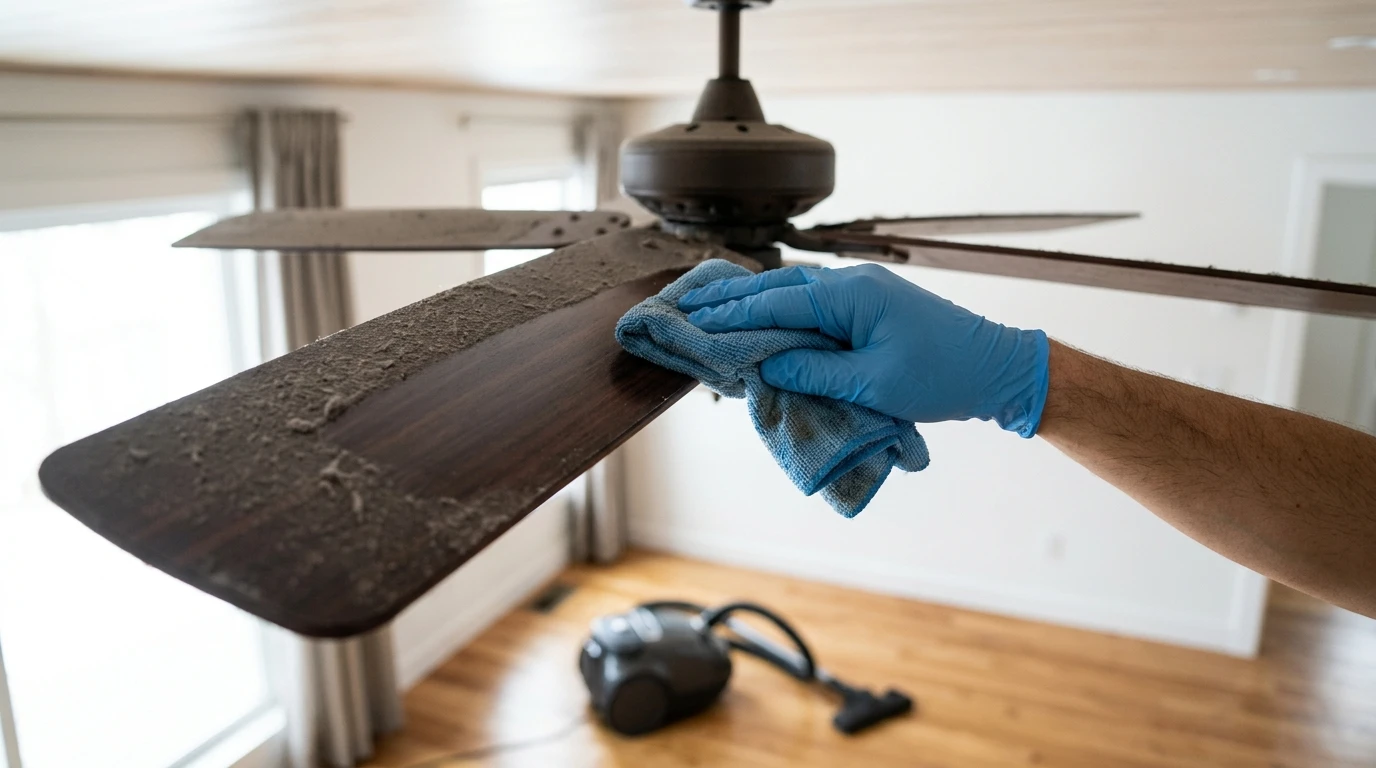
The EPA’s air-cleaner guidance is clear that the most effective ways to improve indoor air are reducing the sources of pollutants and ventilating, with filtration as a supplement. This plan follows that order: first stop dust from getting in, then remove what’s left efficiently. It’s the practical way to prevent dust in your house instead of just chasing it.
- Upgrade the furnace filter and put it on a schedule. Use MERV 13 if your system allows it, check it monthly during heating season and replace it whenever it looks gray or clogged.
- Stop dust at the door. Put mats outside and inside, make shoes-off the house rule and keep a boot tray by the door for winter.
- Seal the obvious gaps. Weatherstrip exterior doors, caulk window trim and have an HVAC contractor check the ducts if dust seems to come from the vents.
- Get humidity into range. Keep a hygrometer in the main living area, stay under 50% and follow the lower winter limits in the table above.
- Dust top-down with a damp microfiber cloth. Rinse or swap cloths often so you don’t carry dust from room to room.
- Vacuum weekly with a sealed HEPA vacuum. The American Lung Association recommends weekly HEPA vacuuming; our guide to HEPA vacuum cleaning explains what to look for.
- Wash bedding weekly in hot water. Use water of at least 120°F, and rotate curtains, throws and pet beds through the wash.
- Cut down on dust shelves. Fewer knickknacks, paper stacks and open shelves mean fewer surfaces to catch dust; the American Lung Association also recommends reducing clutter.
- Add a HEPA air purifier as a supplement. A bedroom purifier catches airborne particles, but it won’t remove dust that has already settled.
- Put the routine on a calendar. Consistency is what keeps dust from building back up; see the schedule below.
A Realistic Dust-Control Schedule
This routine keeps dust in check without taking over your weekends. The weekly vacuuming and bedding frequencies follow American Lung Association recommendations; the rest reflect the schedule our cleaning teams use in Wisconsin homes.
| Task | How often | Why it matters |
|---|---|---|
| Damp-dust reachable surfaces | Weekly | Removes dust before it spreads |
| HEPA-vacuum floors and rugs | Weekly | Pulls dust out of carpet reservoirs |
| Wash bedding in hot water | Weekly, at 120°F or hotter | Reduces dust mite allergens |
| Check furnace filter | Monthly in heating season | A loaded filter stops working well |
| Ceiling fans, vent covers, baseboards, blinds | Monthly | High spots feed dust downward |
| Wash curtains and throws; vacuum mattress and upholstery | Every 1–3 months | Fabrics hold fine dust and fibers |
| Windows, screens and tracks | Spring and fall | Clears pollen and grit at entry points |
| Replace filter and clean top to bottom | After a renovation or smoke event | Removes fine particles before they recirculate |
For the spring reset, our spring cleaning checklist covers windows, screens and the rest of the seasonal list.
What a House Cleaner Can Fix, and When You Need an HVAC Pro
Many dust articles are written by companies that sell a single fix, whether that’s duct cleaning, a new HVAC system or an air purifier. Here’s a straightforward look at who actually handles each dust source.
| Dust source | Can a house cleaner handle it? | Who handles it |
|---|---|---|
| Settled dust on surfaces, fans, baseboards, blinds, vent covers | Yes | House cleaner or homeowner |
| Surface dust in carpets, rugs and upholstery | Yes, by vacuuming | Cleaner; carpet specialist for shampooing |
| Furnace filter replacement | Usually a homeowner task | Homeowner or HVAC technician |
| Leaky ducts, airflow balance, ventilation | No | HVAC contractor |
| Duct cleaning (mold, vermin, clogged ducts) | No | Duct cleaning company |
| Drafts around windows and doors | No | Handyman or window contractor |
| Fine dust after a renovation | Yes | Post-construction cleaning team |
If you’re weighing duct cleaning, go by the EPA criteria covered above rather than a sales pitch.
Getting Ahead of Dust in Your Wisconsin Home with Badger Luxe Cleaning
Once the source problems are handled, dust control comes down to two things: resetting the layer that everyday cleaning misses, and keeping it from building back. A deep cleaning from Badger Luxe Cleaning covers the high and hidden spots in this article: baseboards, vent covers, ceiling fan blades, blinds, the tops of cabinets, and behind and under furniture. A recurring cleaning plan then keeps up with it on a schedule that fits your home, with more attention where you need it, whether that’s a pet-heavy household, the middle of heating season or the weeks after a remodel.
Our cleaning professionals are local, background-checked and highly trained, and we use non-toxic, eco-friendly green cleaning products, which matters when the goal is healthier indoor air and not just shiny surfaces. Every visit follows a customized cleaning checklist, so the spots that matter in your house, like the dusty upstairs bedroom, the mudroom or the vent covers, get covered every time. There’s no long-term contract: book a one-time clean or go month-to-month and cancel anytime without penalty. Pricing is transparent, and you can estimate a deep clean with our deep cleaning cost calculator before you book. If someone in your household has allergies or asthma, our guide to keeping Wisconsin homes allergy- and dust-free with recurring cleaning covers the next step.
FAQ
Is a dusty house unhealthy?
For many people, dust is mainly a nuisance, but it can trigger symptoms in people who are sensitive to what’s in it. ACAAI lists sneezing, a runny or stuffy nose, itchy and teary eyes, coughing, wheezing and chest tightness among dust allergy symptoms. Indoor air matters because we spend so much time inside: according to the EPA’s Report on the Environment, Americans spend about 90% of their time indoors, and concentrations of some pollutants are often 2 to 5 times higher indoors than typical outdoor levels. If dust seems to affect someone’s breathing, talk to a doctor.
Do air purifiers really reduce dust?
A purifier with a true HEPA filter can capture fine airborne particles, including dust, so it can help, especially in a bedroom. But it only works on dust that’s in the air; it does nothing for dust already sitting on shelves, floors and fabrics. The EPA considers source control and ventilation the most effective ways to improve indoor air, with air cleaning as a supplement, so treat a purifier as backup to the steps above rather than a replacement for them.
What pulls dust out of a house, and is there anything that absorbs it?
Nothing passively absorbs dust from a room. What actually removes it is your furnace filter while the system fan is running, a HEPA air purifier, a sealed HEPA vacuum and a damp microfiber cloth that traps dust instead of scattering it. Used together on a steady schedule, those four do far more than any single gadget.
How often should you dust your house?
For most homes, dusting reachable surfaces weekly and hitting high and hidden spots monthly keeps dust from building up. Homes with pets, allergy sufferers, a recent renovation or a long heating season often need more frequent attention. If you’re deciding how often to bring in professional help, our comparison of weekly vs. bi-weekly house cleaning breaks down the trade-offs.
Does air duct cleaning get rid of dust?
Not reliably. The EPA says studies don’t conclusively show that dirty ducts raise dust levels in homes, and it reserves duct cleaning mainly for visible mold, vermin or ducts clogged badly enough to release debris into the house. For everyday dust, a better filter, sealed ducts and a consistent cleaning routine usually do more.
If you’ve worked through the causes and the dust keeps winning, a professional reset can take the pressure off. You can book a deep clean online and ask about a recurring plan built around your home, or reach our Green Bay team at (920) 777-9609 or nathan@badgerluxecleaning.com.