Janitorial services are the routine, repeating upkeep that keeps a building usable day to day: emptying trash, cleaning and restocking restrooms, vacuuming and mopping floors, dusting and wiping high-touch surfaces on a daily or weekly schedule. Commercial cleaning is the broader term for professional cleaning of business premises, and in everyday use it often means the deeper, periodic, equipment-heavy jobs that routine visits don’t cover, such as carpet extraction, floor stripping and refinishing, or post-construction cleanup. So the practical answer to janitorial vs commercial cleaning is that most businesses need both: a routine janitorial schedule as the base, with periodic projects planned around it.
The terms get mixed up because vendors, contracts and even industry groups use them differently. Here’s what each one means, how they compare, and how a Wisconsin office, clinic or shop can decide what to book.
Key Takeaways
- Janitorial services are routine, repeating cleaning (trash, restrooms, floors, dusting, high-touch surfaces), usually done daily or weekly.
- “Commercial cleaning” is used two ways: as the umbrella term for all professional cleaning of business premises, and as shorthand for deeper periodic projects.
- The practical dividing line is frequency: janitorial tasks repeat on every visit, while periodic work happens monthly, quarterly or once or twice a year.
- Carpet shows the split clearly: vacuuming is routine, while carpet-industry guidance puts a full cleaning, done the way the manufacturer specifies, at roughly every 12 to 18 months.
- Most businesses need a routine janitorial plan plus a calendar of periodic projects. HVAC work, plumbing and repairs belong to facility maintenance, not a cleaning crew.
What Janitorial Services Mean
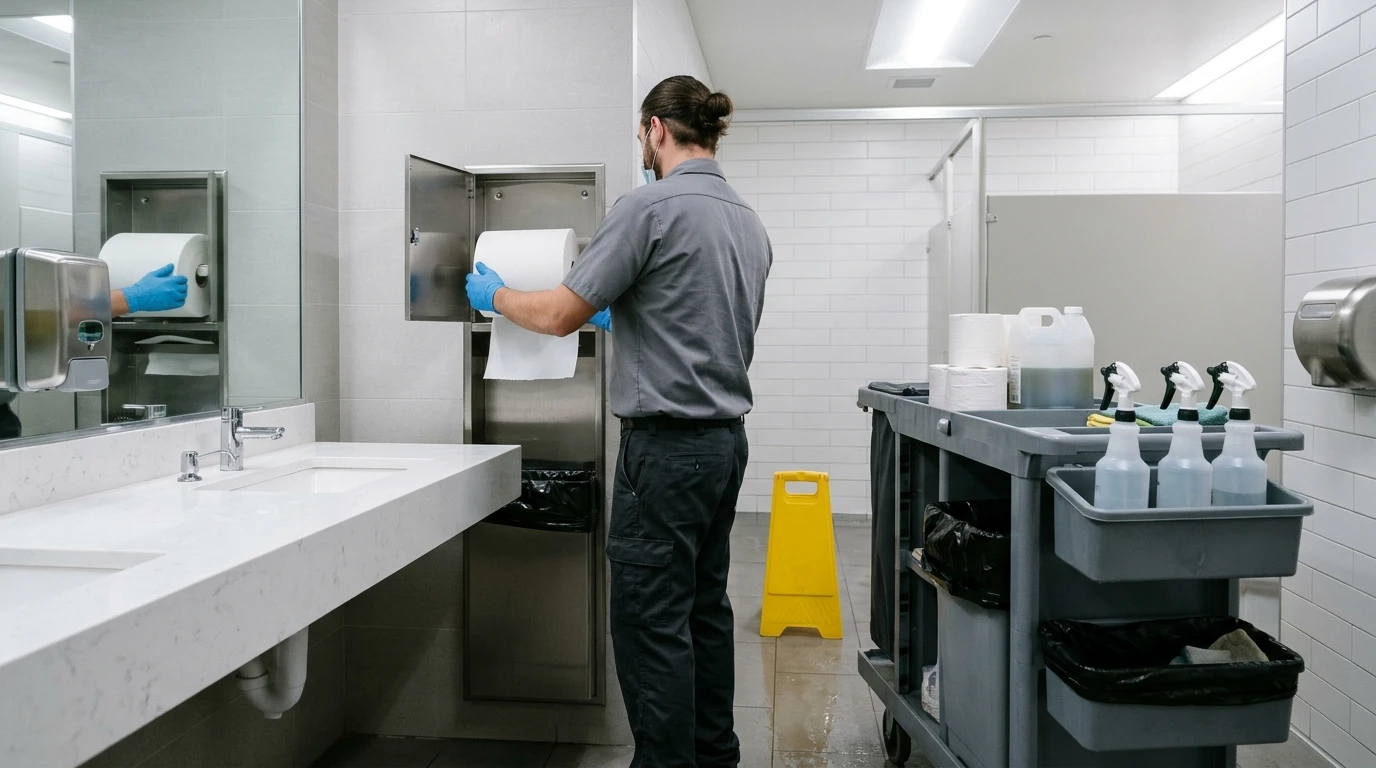
Janitorial services are routine cleaning tasks performed on a set, repeating schedule to keep a commercial building clean, sanitary and ready for use. That’s the short answer to what is meant by janitorial services, and it matches the plain janitorial meaning most buyers have in mind: the work that has to happen on every visit, not once in a while.
The U.S. Bureau of Labor Statistics’ Occupational Outlook Handbook sums up the job this way: janitors and building cleaners “keep many types of buildings clean, sanitary, orderly, and in good condition.” So what are janitorial services on a typical office visit? Usually:
- Trash and recycling: emptying bins, replacing liners and taking waste out to the dumpster.
- Restrooms: cleaning toilets, sinks, mirrors and floors, and restocking paper towels, toilet paper and soap.
- Floors: sweeping, vacuuming and mopping, with extra attention at entrances and busy hallways.
- Dusting: desks, sills, ledges and other surfaces within normal reach.
- High-touch surfaces: wiping door handles, light switches, railings and shared equipment.
- Glass and spot cleaning: entry doors, interior glass and fingerprints on partitions.
- Break rooms: counters, sinks, tables and appliance exteriors.
Exactly what does janitorial services include beyond that varies by provider. BLS also lists minor building repairs, telling managers about major repairs and locking doors among janitors’ typical duties; for a contracted crew, those extras depend on the agreement. For a room-by-room view of how office janitorial services break down, see what a recurring office cleaning plan covers area by area. Timing is flexible too: BLS notes that many cleaners work evening hours, since offices are often cleaned after everyone goes home.
What Commercial Cleaning Means
Two Meanings of “Commercial Cleaning”
The commercial cleaning meaning depends on who’s using the phrase. In the broad sense, it’s an umbrella term. ISSA, the cleaning industry association, defines it as “professional cleaning services provided to businesses, institutions, and commercial buildings,” and it lists routine janitorial services as one type of commercial cleaning. By that definition, every janitorial contract is commercial cleaning.
In the narrower, everyday sense, many cleaning companies and buyers use “commercial cleaning” to mean deeper, specialized work that happens less often and needs heavier equipment. That’s the sense we use in the rest of this article.
This double meaning is why quotes get confusing. One provider’s commercial janitorial services may include quarterly carpet care; another’s may stop at trash, restrooms and floors. Contracts often use the words interchangeably, so put the actual scope in writing rather than relying on the label.
What Periodic Commercial Cleaning Usually Includes
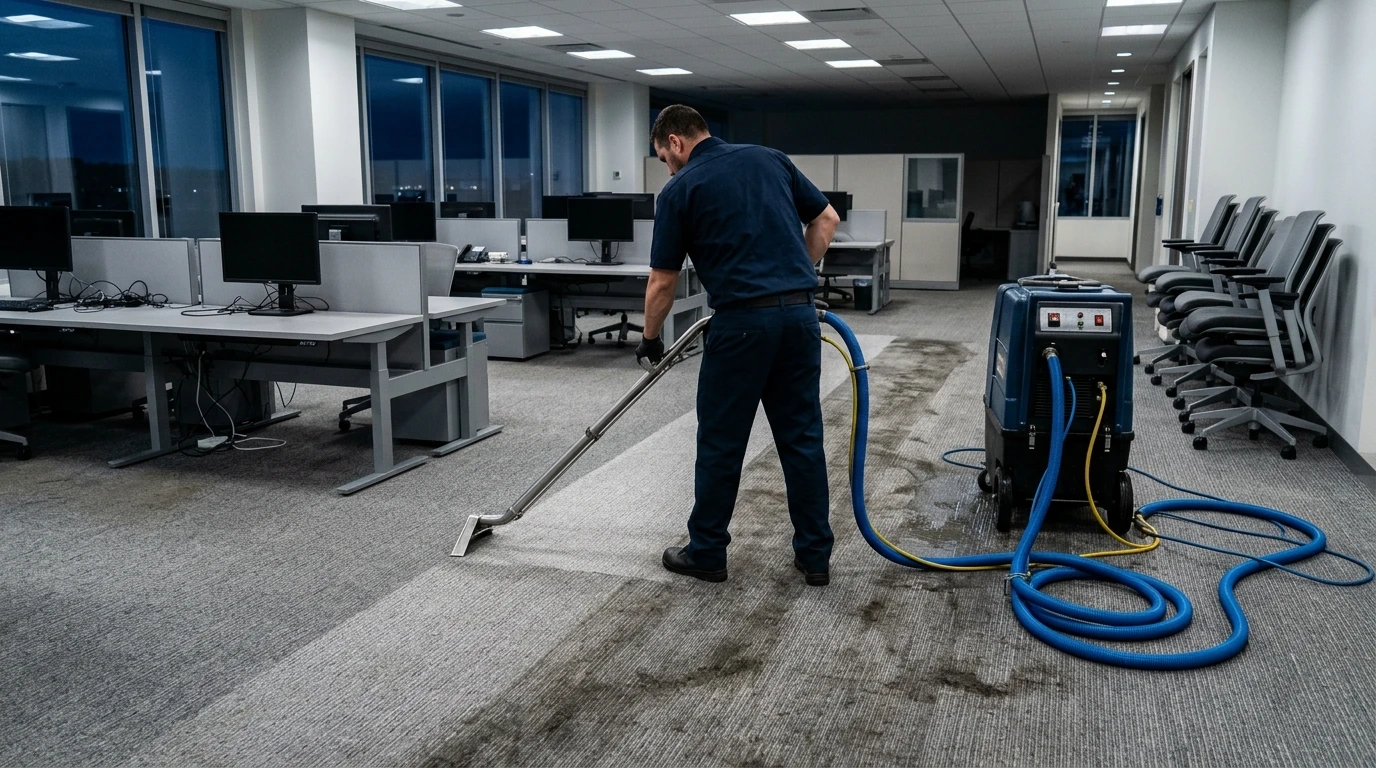
- Carpet extraction: hot-water cleaning that pulls out embedded soil vacuuming leaves behind.
- Hard-floor care: stripping old finish, applying new wax or finish, and burnishing.
- Tile and grout: deep scrubbing in restrooms, kitchens and entryways.
- Upholstery: cleaning lobby seating, office chairs and break-room furniture.
- High dusting: vents, light fixtures, cabinet tops and ledges out of normal reach.
- Full glass cleaning: interior windows and partitions cleaned edge to edge, not just spot-wiped.
- Construction cleanup: post-construction cleaning after a remodel, build-out or tenant improvement.
- Targeted disinfection: a focused treatment after an illness outbreak or a specific incident.
Some jobs that show up on lists like this are usually separate specialties: pressure washing of sidewalks and building exteriors, exterior or high-rise window work that needs lifts or rope access, and biohazard cleanup, which calls for a certified remediation company. A good provider tells you plainly which of these it handles and which it doesn’t.
Janitorial vs Commercial Cleaning: Side-by-Side
The table below compares routine janitorial services with periodic commercial cleaning across the factors that shape your schedule and budget.
| Factor | Janitorial Services | Periodic Commercial Cleaning |
|---|---|---|
| Purpose | Keep the space clean and usable every day | Restore surfaces and remove built-up soil |
| Typical frequency | Daily to weekly | Monthly to 1–2 times per year |
| Typical tasks | Trash, restrooms, floors, dusting, high-touch surfaces | Carpet extraction, floor refinishing, grout, upholstery, high dusting |
| Timing | During or after business hours | Usually after hours or on weekends, booked ahead |
| Equipment & chemicals | Vacuums, mops, microfiber, everyday cleaners | Extractors, floor machines, floor finish, specialty products |
| Crew & training | Regular crew following a set checklist | Crew trained on specific machines and surfaces |
| How it’s billed | Recurring plan (per visit or per month) | Quote per project |
That billing difference matters when you compare quotes: a recurring plan and a per-project quote aren’t priced the same way. For local numbers, see our commercial cleaning prices guide for Green Bay.
A Legal Line Between the Two (Washington’s Example)
The difference isn’t just industry jargon. The Washington State Department of Revenue describes janitorial services as those “regularly and normally performed by a commercial janitorial business,” listing examples such as dusting, disposing of trash, cleaning and waxing floors, cleaning interior walls and woodwork, and cleaning interior and exterior window surfaces. Anything outside that list is treated as “specialized or non-repetitive cleaning services” and taxed differently. It’s a Washington tax rule, not a Wisconsin one and not tax advice; we mention it only because a government agency draws the same repetitive vs non-repetitive line. Washington even files floor waxing under janitorial work, which shows how blurry the edges are and why scope should be defined task by task.
Janitorial, Custodial, Day Porter, Facility Maintenance: Who Handles What
Several overlapping terms show up in quotes, contracts and job postings. This table compares what each one usually means, how often it happens and who typically does the work.
| Term | What It Usually Means | Typical Frequency | Who Usually Does It |
|---|---|---|---|
| Janitorial services | Routine cleaning on a set checklist | Daily to weekly | In-house janitor or contracted cleaning company |
| Custodial services | The same routine work, in institutional settings | Daily | Custodians at schools, hospitals, public buildings |
| Commercial cleaning (umbrella) | Any professional cleaning of business premises | Varies by service | Cleaning companies |
| Periodic, project or “maintenance” cleaning | Deeper work on floors, carpet, grout, upholstery | Monthly to 1–2 times per year | Cleaning company, sometimes a floor or carpet specialist |
| Day porter | Janitorial coverage during business hours | Daily, for set hours on site | Contracted porter or in-house staff |
| Facility maintenance | HVAC filters, plumbing, lighting, repairs | As needed or on a maintenance plan | Facility manager, HVAC technician, plumber |
“Maintenance cleaning” is the trickiest label here, because providers use it for both routine upkeep and periodic floor and carpet work (more on that in the FAQ).
Janitorial vs Custodial
When it comes to janitorial vs custodial, the difference is mostly about the setting, not the tasks. BLS puts it plainly: “Custodians are janitors or cleaning workers who typically maintain institutional facilities, such as schools and hospitals.” A school district usually employs custodians; an office building usually contracts janitorial services. The day-to-day work is largely the same.
Where Day Porters Fit
Day porter services are janitorial work done during business hours instead of after them: restocking restrooms at midday, emptying bins before they overflow, wiping up spills in the lobby. They make the most sense in busy buildings such as medical offices, retail spaces or multi-tenant lobbies, where a single evening visit can’t keep up with foot traffic. Our guide to day porter vs night cleaning compares the two schedules in detail.
What You’re Seeing vs What You Actually Need
If you’re not sure which service to book, start with the problem in front of you. This table matches common symptoms to their likely cause and the service that fixes them.
| What You Notice | Likely Cause | What to Book |
|---|---|---|
| Full bins and empty paper dispensers by mid-afternoon | Visits too infrequent for your headcount | More janitorial visits or a day porter |
| Gray traffic lanes on carpet despite regular vacuuming | Soil embedded below the surface | Periodic hot-water carpet extraction |
| Dull, scuffed hard floors that mopping doesn’t fix | Worn floor finish | Strip and refinish project |
| Fine dust on every surface after a remodel | Construction dust | Post-construction cleaning |
| Several employees out sick at the same time | Germs left after routine cleaning | Targeted disinfection of high-touch areas |
| Musty smell from vents, a leaking fixture | Equipment or building problem | HVAC technician or facility maintenance, not a cleaner |
| Gray, gritty entrance floors in winter | Tracked-in salt, sand and slush | More entrance care in the janitorial plan; floor project in spring |
Two of these rows rest on published guidance. The Carpet and Rug Institute says carpet “should always be cleaned the way the manufacturer specifies approximately every 12 to 18 months” and that it’s best to vacuum at least twice a week: vacuuming is routine janitorial work, extraction is a periodic project (and heavily used commercial carpet often needs it sooner).
For illness, the CDC explains that cleaning alone removes most types of harmful germs, while disinfecting can kill harmful germs that remain on surfaces after cleaning, and it recommends disinfecting where people have clearly been sick, using an EPA-registered product. So targeted disinfection is an add-on with a specific trigger, not a nightly default; our sanitize vs disinfect guide explains when each step makes sense. The winter-entrance row comes from our own experience cleaning Wisconsin businesses, not from a published standard.
What Do You Need? Matching the Service to Your Business
For most businesses, the answer isn’t one or the other. Routine janitorial service is the base, and periodic commercial cleaning is scheduled around it. The baseline isn’t optional, either: OSHA’s sanitation standard, 29 CFR 1910.141, states that “all places of employment shall be kept clean to the extent that the nature of the work allows” and that washing facilities “shall be maintained in a sanitary condition.” OSHA doesn’t set a cleaning frequency or require you to hire a contractor, but a routine janitorial schedule is the practical way to stay at that standard week after week.
A Sample Annual Cleaning Calendar for a Small Office
Here’s how routine and periodic tasks can fit together over a year in a typical small office. Apart from the carpet row, which follows CRI guidance, these frequencies are our usual starting point; headcount, foot traffic and floor types will move them up or down.
| How Often | Tasks | Service Type |
|---|---|---|
| Every visit | Trash, restrooms and restocking, high-touch surfaces, break room, entry and traffic-lane vacuuming | Janitorial |
| Weekly | Full vacuuming and mopping, dusting, interior glass | Janitorial |
| Monthly | Baseboards, vents, high ledges | Janitorial add-on or periodic |
| Quarterly | Upholstery spot cleaning, deep restroom grout scrubbing | Periodic |
| Every 12–18 months (or per manufacturer) | Hot-water carpet extraction | Periodic |
| 1–2 times per year | Hard-floor strip and refinish (spring works well after a Wisconsin winter) | Periodic |
If you’re unsure how often the routine visits themselves should happen, our article on daily vs weekly office cleaning walks through the trade-offs.
When One Service Is Enough
A small, low-traffic office might do fine with weekly office janitorial services and a carpet cleaning every year or so. A business that already employs its own custodian may only need an outside crew for periodic projects such as floors, carpet or post-renovation cleanup. Both models are common: according to BLS, about 35% of janitors and building cleaners work in the “services to buildings and dwellings” industry, meaning contracted cleaning firms, while many others are employed directly by schools, hospitals and other organizations.
Regulated settings change the picture: medical and dental offices and food-service businesses need tighter disinfection protocols built into the routine schedule itself. See how medical office cleaning differs from regular office cleaning if that applies to you.
Scope Questions to Settle Before You Get a Quote
Whatever label a provider uses, the scope is what you’re actually buying. Settle these points before you compare quotes side by side:
- Which periodic tasks are included in the recurring price, and which are quoted separately as add-ons?
- How often is each area cleaned (restrooms, kitchen, offices, entrances), and is that written into the checklist?
- Who supplies consumables such as paper towels, toilet paper, soap and trash liners?
- How will the crew get in after hours, and who is responsible for keys, alarm codes and locking up?
- What triggers disinfection, which areas does it cover, and does the crew use EPA-registered products as the CDC recommends?
- Are the cleaning staff background-checked?
- How long is the contract, and what does it take to cancel or change the schedule?
For a broader approach to vetting providers, see these tips for finding a reliable commercial cleaner. If your first visit will be a deep clean, here’s how to prepare your office for its first professional deep clean.
Routine Upkeep and Periodic Projects From One Local Wisconsin Crew
Badger Luxe Cleaning handles both halves of this article. Our commercial cleaning services cover recurring janitorial schedules for offices and other business spaces, add-ons such as floor waxing, carpet cleaning and sanitization, and one-time projects like post-construction cleanup. We build a customized cleaning checklist for your space that combines routine tasks with the periodic ones on your calendar, so both are planned together.
Our cleaning professionals are local, background-checked and highly trained, and we use non-toxic, eco-friendly products. (If green products matter to you, the EPA’s Safer Choice program is a useful reference when you weigh any provider’s product claims.) There’s no long-term contract: book a one-time project or a month-to-month schedule, and cancel anytime without penalty. Pricing is transparent, and our Wisconsin experience means we plan for winter salt and slush at your entrances. We work with businesses in Green Bay and across the state, including commercial cleaning in Milwaukee and commercial cleaning in Madison. Pressure washing, HVAC work and building repairs aren’t on our service list; those belong with the specialists described above.
FAQ
Is janitorial the same as commercial cleaning?
Not exactly. Commercial cleaning is the broad term for professional cleaning of business premises, and janitorial services are one part of it: the routine, repeating work. In everyday use, though, “commercial cleaning” often refers to deeper periodic jobs like carpet extraction or floor refinishing, so it’s worth asking any provider which meaning they’re using.
What does janitorial services include?
Typically trash removal, restroom cleaning and restocking, floor care, dusting, and wiping high-touch surfaces, often plus break rooms and spot-cleaning glass. Deeper work such as carpet extraction or floor stripping is usually quoted separately.
What is considered a commercial cleaner?
A commercial cleaner is a person or company that cleans business, institutional or other non-residential spaces, such as offices, clinics, stores, schools and warehouses. The term covers both routine janitorial staff and crews that handle periodic projects like floor care and post-construction cleanup.
Is janitorial cleaning the same as maintenance cleaning?
It depends on who’s using the term. Some providers say “maintenance cleaning” for the deeper, periodic work that protects floors and carpet, while others use it for routine upkeep. Janitorial cleaning is always the routine part, so ask exactly which tasks and frequency a “maintenance” quote includes.
How much do janitorial services cost?
Cost depends on your square footage, how often the crew visits, how many restrooms you have and what kinds of floors need care. Routine service is usually a recurring plan and periodic projects are quoted per job; the commercial cleaning prices guide linked above covers local pricing.
Do I need a long-term contract for janitorial services?
Not with Badger Luxe Cleaning. You can book a one-time project or a month-to-month schedule and cancel anytime without penalty. Whichever provider you choose, read the cancellation and schedule-change terms before you sign.
Not sure whether your business needs routine janitorial service, a one-time project or a mix of both? Call Badger Luxe Cleaning at (920) 777-9609 or email nathan@badgerluxecleaning.com, tell us how your space is used, and we’ll talk through a schedule of routine and periodic tasks that fits it.