Cleaning Services — Blog — Restaurant Cleaning Checklist: What Every Green Bay Kitchen Needs
A restaurant lives and dies on its cleanliness. One failed health inspection, one online review mentioning a sticky table or a smell near the restrooms — and the damage to your reputation in Green Bay’s competitive dining scene is immediate. A solid restaurant cleaning schedule isn’t a nice-to-have. It’s the operational foundation that keeps your kitchen running, your staff safe, and your customers coming back.
This checklist covers everything from daily front-of-house tasks to monthly deep cleaning — organized by frequency and area so your team always knows what needs doing and when.
Why a Rigorous Restaurant Cleaning Schedule is Essential for Success
Wisconsin health inspection standards leave little margin for error. DATCP inspectors evaluate everything from sanitizing solution ratios to how food is stored and labeled. A missed task on your restaurant cleaning schedule isn’t just an inconvenience — it’s a potential violation that can result in fines, forced closures, or worse.
A consistent recurring cleaning schedule also prevents the buildup of grease and pathogens that cause long-term facility damage — warped wood, corroded equipment, and persistent odors that no single deep clean can fully fix. The benefits extend well beyond compliance:
Customer loyalty — diners notice clean environments and return to them. Dirty restrooms, sticky surfaces, and streaked glassware are the fastest way to lose repeat business.
Staff morale — kitchen teams work better in clean, organized environments. Cross-contamination prevention starts with staff who trust the space they’re working in.
Fire safety — grease accumulation on exhaust hoods and cooking equipment is one of the leading causes of commercial kitchen fires. Regular degreasing is a direct safety measure.
Regulatory compliance — a documented cleaning schedule demonstrates due diligence to inspectors and protects your establishment from violations tied to preventable buildup.
Daily Front-of-House (FOH) Cleaning Tasks for Guest Satisfaction
First impressions in Green Bay’s dining scene are made at the door — before a single dish leaves the kitchen. The front of house sets the tone for your entire guest experience, and daily attention to these areas is non-negotiable. Foodborne illness risk doesn’t only live in the kitchen; improperly sanitized menus, bar surfaces, and high-touch contact points in the dining room all contribute to health code exposure.
A reliable recurring cleaning routine for FOH keeps these risks in check without requiring end-of-shift staff to make judgment calls about what’s been addressed.
Entrance and Dining Area Maintenance
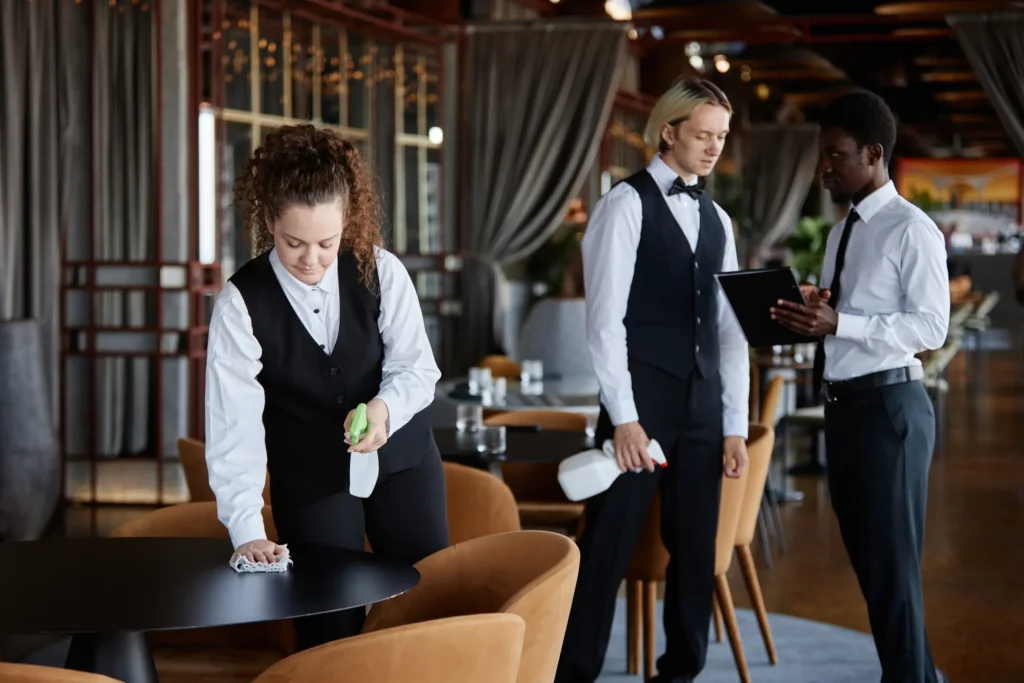
The dining area should be reset completely between service periods and spot-checked throughout. Daily tasks include:
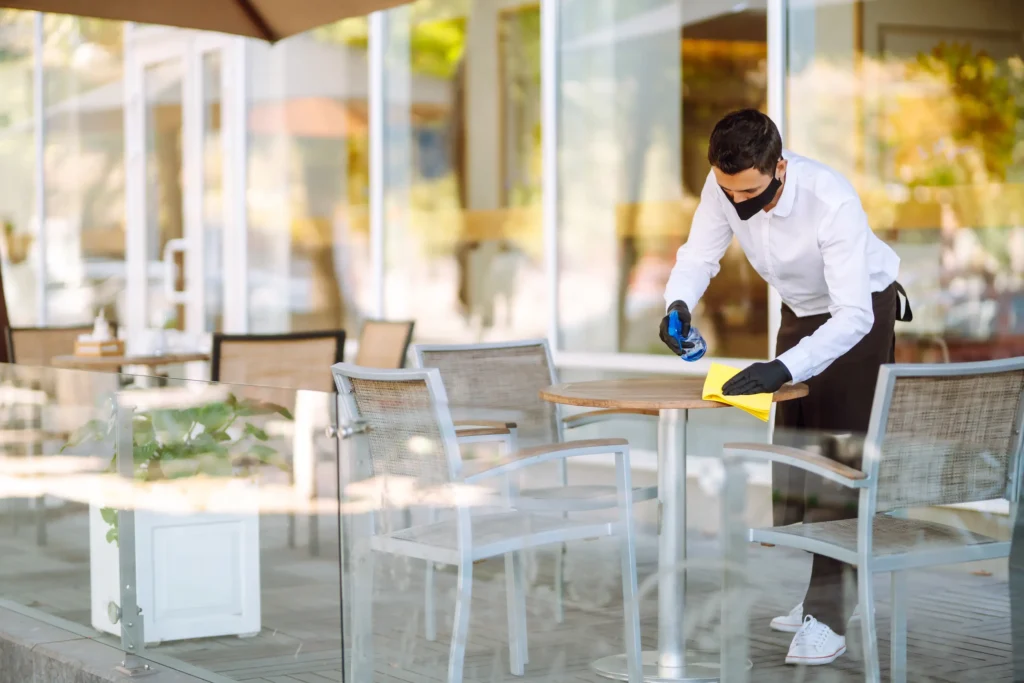
Wiping door handles and host stand surfaces — high-touch surface disinfection at the entrance should happen every two to three hours during service, not just at open and close.
Cleaning windows and glass panels — smudged glass at the entrance or between dining areas reads as neglect regardless of how clean everything else is.
Vacuuming carpets and sweeping hard floors — crumbs and tracked-in debris accumulate quickly; address between service periods, not only at close.
Sanitizing menus — physical menus should be wiped with an appropriate sanitizing solution after every use. QR-only menus still require the table surface to be disinfected.
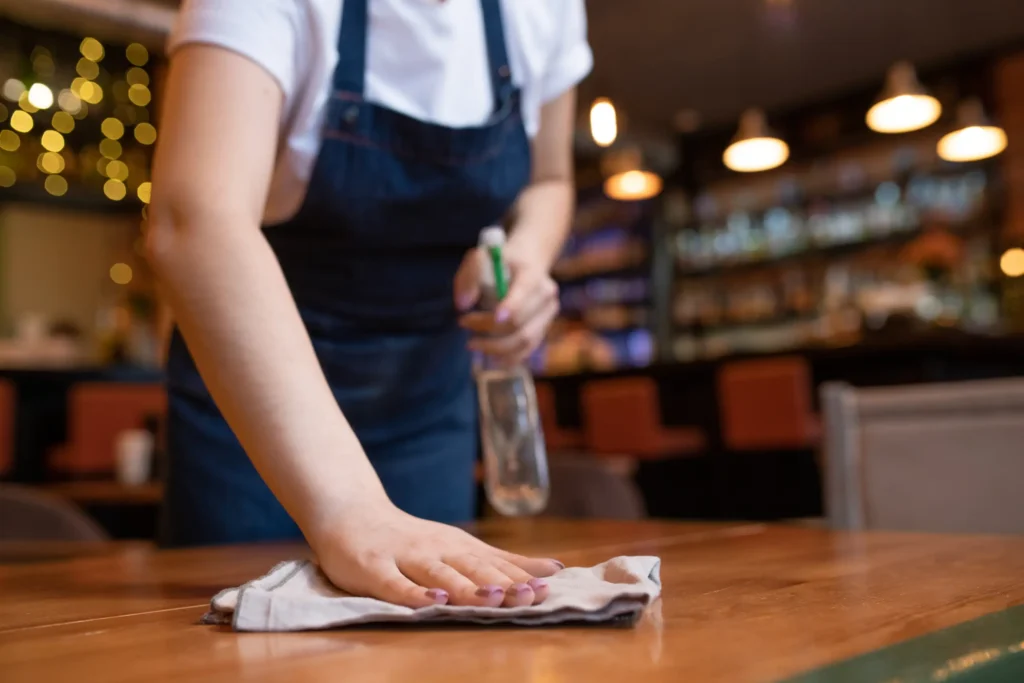
Disinfecting tables between seatings — use correct sanitizing solution ratios per Wisconsin DATCP guidelines; too diluted is ineffective, too concentrated leaves residue.
Bar Area and Beverage Station Sanitation
The bar requires its own daily cleaning protocol distinct from the general dining area. Beverage service equipment creates buildup quickly and in ways that aren’t always visible.
Cleaning soda gun tips and nozzles — sugar residue in soda lines and gun heads is a direct foodborne illness risk if left overnight.
Wiping down beer taps and drip trays — drip trays should be emptied and sanitized at close; beer tap exteriors wiped during service as needed.
Sanitizing bar counters and speed rails — the bar counter is a high-contact surface throughout service; treat it with the same attention as prep surfaces in the kitchen.
Non-slip floor treatment — bar floors accumulate spilled liquid and should be mopped with a non-slip floor treatment at close to prevent early morning slip hazards.
Back-of-House (BOH) and Commercial Kitchen Cleaning Checklist
BOH hygiene is the core of your food safety operation. This is where commercial cleaning standards intersect directly with Wisconsin DATCP requirements — and where the consequences of cutting corners are most serious. Every task in the back of house is a cross-contamination prevention measure, not just a cleanliness preference.
Chemical storage safety is also a BOH responsibility: cleaning products must be stored separately from food, properly labeled, and used at correct concentrations. An inspector finding improperly stored chemicals is an automatic violation regardless of how clean everything else looks.
Prep Stations and Cooking Equipment
This is the daily restaurant cleaning checklist core — the tasks that must be completed at every close without exception. Degreasing exhaust hoods, wiping down prep tables, and cleaning cooking equipment prevent the accumulation that turns into a monthly commercial kitchen cleaning problem if ignored nightly.
Cleaning grills and flat-tops — scrape and degrease cooking surfaces while still warm; baked-on grease requires commercial grade degreasers and significantly more effort when cold.
Emptying and cleaning crumb trays — grease and debris in crumb trays is a direct fire hazard; empty and wipe nightly without exception.
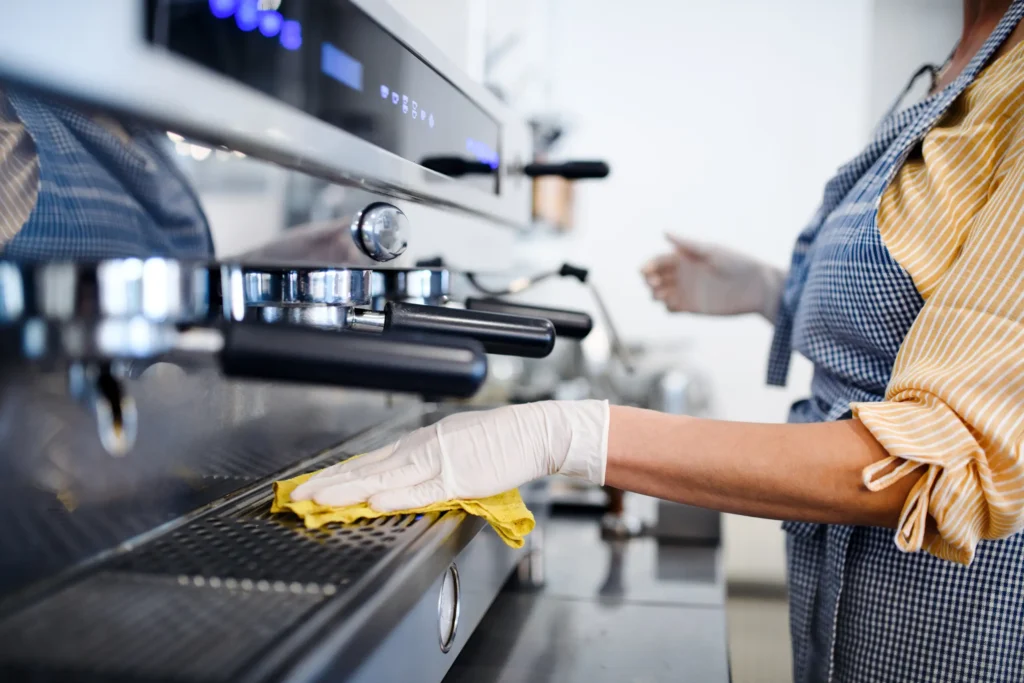
Wiping down prep tables and cutting boards — sanitize all food contact surfaces with an approved solution at end of service; cross-contamination prevention depends on this step happening correctly every night.
Washing smallwares and utensil holders — knife blocks, utensil crocks, and smallware containers accumulate residue that standard dishwashing doesn’t always reach.
Dishwashing and Storage Area Hygiene
The “wet” areas of your kitchen are where mold, mildew, and bacterial growth happen fastest. The commercial kitchen cleaning schedule for these areas should include cleaning the interior of the dishwasher itself — not just running it. Spray arms, filters, and door gaskets accumulate food debris that degrades wash performance and becomes a contamination source.
Walk-in coolers and dry storage should be organized using the FIFO inventory method (first in, first out) — rotate stock at every delivery and check for expired items daily. Walk-in cooler maintenance includes wiping door gaskets, checking temperature logs, and sweeping floors at close. Storage area floors should be swept nightly and mopped as part of the weekly restaurant cleaning checklist.
Weekly and Monthly Deep Cleaning: Tackling the Hidden Grime
Daily cleaning keeps a restaurant operational. Weekly and monthly tasks address the buildup that daily routines can’t reach — behind line equipment, inside exhaust systems, and in floor drains. When this work is neglected, you eventually need a full deep cleaning session to reset the facility before standard maintenance can resume.
Frequency
Task
Purpose
Weekly
Clean floor drains throughout kitchen
Prevent odors, fruit flies, and drain blockages
Weekly
Degrease exhaust hood filters
Reduce fire risk and maintain airflow
Weekly
Wipe down walk-in cooler walls and shelving
Prevent mold growth and cross-contamination
Weekly
Sanitize restaurant restrooms thoroughly
Address grout, fixtures, and high-touch surfaces beyond daily wipe-downs
Monthly
Deep clean vent hoods and exhaust ducts
Fire code compliance; grease accumulation in ducts is a serious hazard
Monthly
Grease trap maintenance and inspection
Prevent drain backups and odor; required by most municipal codes
Monthly
Clean behind and under all line equipment
Remove grease and debris buildup that daily cleaning can’t reach
Monthly
Inspect and clean walk-in cooler coils
Maintain refrigeration efficiency and prevent equipment failure
How to Clean a Commercial Kitchen Like a Pro: A Step-by-Step Guide
Kitchen staff following a consistent end-of-shift workflow produce better results than staff cleaning freestyle. This food service cleaning checklist step-by-step gives your team a logical sequence that prevents missed steps and ensures surfaces are cleaned in the right order — so you’re not re-contaminating a sanitized surface by working above it.
Clear all food from surfaces and equipment — remove every food item from prep surfaces, wrap and store anything being kept, and dispose of anything that can’t be held. Nothing gets cleaned until food is cleared.
Apply commercial grade degreaser to cooking equipment and surfaces — allow dwell time as specified on the product label; degreaser needs contact time to break down grease effectively. Don’t rush this step.
Scrub all surfaces in order from top to bottom — start with overhead equipment and shelving, work down to prep surfaces, then to equipment exteriors, and finish at floor level. Cleaning top-to-bottom prevents debris from falling onto already-cleaned surfaces.
Rinse all surfaces and apply sanitizing solution at correct concentration — rinsing removes degreaser residue; sanitizing kills pathogens. These are two separate steps. Using only degreaser without a final sanitizing solution does not meet Wisconsin food code requirements.
Floor care last — sweep to collect all solid debris, mop with appropriate cleaner, apply non-slip floor treatment where required, and allow to dry fully before reopening the space to foot traffic.
Why Green Bay Restaurants Choose Badger Luxe Cleaning
End-of-shift kitchen staff are tired. They’ve been on their feet for hours, service was busy, and the last thing they have capacity for is a thorough, detail-oriented commercial kitchen cleaning checklist. The result is shortcuts — tasks partially done, surfaces wiped rather than sanitized, grease traps ignored for another week.
Badger Luxe Cleaning brings professional crews to Green Bay restaurants with the equipment and training to do this work correctly: industrial degreasers, HEPA-filtered equipment for dry areas, documented protocols that match Wisconsin DATCP standards, and a consistency that tired kitchen staff can’t reliably deliver at close.
We build restaurant cleaning schedules around your operation — your service hours, your inspection calendar, your specific equipment. No generic checklists. No missed items. Call (920) 777-9609 for a free quote, or book a consultation online.
Common questions Green Bay restaurant owners ask about cleaning standards, schedules, and professional services.
Frequently Asked Questions About Restaurant Sanitation
How often should a grease trap be cleaned in a restaurant?
The general rule is the "quarter full" standard: a grease trap should be serviced when the combined depth of grease and solids reaches 25% of the trap's total liquid depth. In practice, this means most moderate-volume restaurants require grease trap maintenance monthly, while high-volume kitchens may need it every two to three weeks. Your municipal code may specify minimum cleaning intervals regardless of volume — check with the City of Green Bay's public works requirements to confirm what applies to your location.
What are the most common health code violations in Wisconsin?
Wisconsin DATCP inspectors most frequently cite improper food temperature storage (hot food below 135°F or cold food above 41°F), missing or incorrect date labels on stored items, and sanitizing solution ratios that are either too weak to be effective or too concentrated and leaving chemical residue on food contact surfaces. Other common violations include improper chemical storage near food, handwashing station accessibility issues, and evidence of pest activity. Most of these are preventable with a consistent daily and weekly cleaning and monitoring routine.
Can I outsource my restaurant cleaning to a professional service?
Yes, and for many Green Bay restaurants it's the more reliable option for deep cleaning and scheduled intensive tasks. Professional services bring specialized equipment — industrial degreasers, commercial-grade extraction equipment, HEPA vacuums — that most kitchens don't own, and trained staff who aren't managing the fatigue of a full service shift. The practical division that works well for most operations: kitchen staff handles end-of-shift daily tasks, and a professional crew handles weekly deep cleaning, monthly intensive work, and any task that requires equipment or expertise beyond what's reasonable to expect from line staff.
Graymond Santos writes the blog posts for Badger Luxe Cleaning, sharing practical tips and creative insights on cleaning and organization. He studied Electronics Engineering for two years at the Technological University of the Philippines in Manila and graduated with honors from Cavite National High School under the Science, Technology, Engineering, and Mathematics (STEM) strand. As part of a group, he contributed to Viajero, a Best Research Award-winning app that celebrates innovation, technology, and the history of Cavite. A lifelong writer and former student journalist with a focus on science and technology, Graymond brings curiosity, creativity, and thoughtful perspective to every post.
Want a Cleaner Workplace?
Our commercial cleaning service is built around your space and your schedule, from small offices to larger buildings.